Metra mischaracterizes why people buy 10-ride tickets

[flickr]photo:8163237703[/flickr]

A outbound Metra commuter rail train leaving the College Ave station in Wheaton, IL on a misty cold election night in November. Photo by Duane Rapp. 

“The 10-ride is meant as a convenience media, offered as a convenience to riders to save them from having to buy 10 one-ways,” said Metra spokesman Michael Gillis. (The 10-ride ticket costs as much as 9 rides.)

The 10-ride ticket is meant to save customers money and attract them to using transit; otherwise it wouldn’t have been priced at the cost of 9 one-way tickets. Saving money is why people pre-pay for several days worth of rides on Chicago Transit Authority and Pace. Selling tickets in bulk – the 10-ride ticket comes on a single piece of paper – saves Metra money, too. And when CTA and Pace customers use prepaid fares instead of cash, those agencies spend less money having to serve as banks and driving armored trucks around town. Continue reading Metra mischaracterizes why people buy 10-ride tickets

Danish Modern: Copenhagen Cycle Chic’s Mikael Colville-Andersen

[flickr]photo:7678910746[/flickr]

Mikael Colville-Andersen with his kids Felix and Lulu-Sophia.

[This article originally ran in Urban Velo magazine.]

As “The Pope of Urban Cycling,” Mikael Colville-Andersen is one of today’s leading bicycle advocates, but also one of the most controversial. He’s known as the kingpin of the stylish cycling movement via his award-winning photo blog Copenhagen Cycle Chic. The site mostly features candid photographs of attractive, well-dressed women on wheels, for a largely female readership. For his day job as CEO of Copenhagenize, a nine-person transportation consulting firm, he travels to cities around the world, advising politicians, planners and advocates on ways to emulate the success of the bike-friendly Danish capital.

Mikael’s blogs have a global following—Cycle Chic has inspired some 150 spin-offs in other cities. He’s also a sought-after public speaker who gave the keynote address at this year’s Pro Walk Pro Bike Pro Place conference in Long Beach, California. But he’s not without his critics. His outspoken opposition to helmet promotion troubles many North American advocates. And at least two female bike bloggers have critiqued his Cycle Chic aesthetic and rhetoric as being sexist, elitist and counterproductive for encouraging regular folks to ride.

In July I visited Copenhagen for the first time and, as advertised, it’s a biker’s paradise with mellow traffic, grade-separated bike lanes on all major streets and good-looking, stylish people on classy Dutch cycles everywhere you turn. I met up with Mikael, a bright-eyed, energetic man, at his flat in Frederiksberg, a town completely surrounded by Copenhagen. We sipped cans of Carlsberg as his young kids Felix and Lulu-Sophia practiced soccer and picked flowers in their lush back yard. Mikael and I discussed his views on helmets, the differences between Copenhagen and Amsterdam, why he’s underwhelmed by Portland, and why bikes should be marketed more like vacuum cleaners.

Continue reading Danish Modern: Copenhagen Cycle Chic’s Mikael Colville-Andersen

New CTA buses and mid-life overhaul of more than 1,000 vehicles will avoid dismal situation 6 years ago

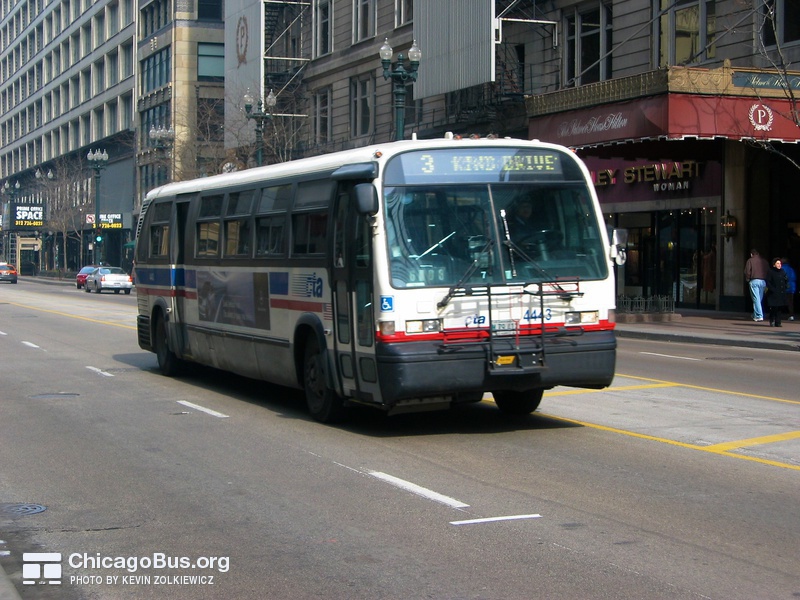
A 4400-series TMC RTS bus on State Street. Photo by Kevin Zolkiwicz.

I arrived in Chicago in 2006 to attend the University of Illinois at Chicago for a sociology and urban planning degree. I visited home in Batavia, Illinois, quite often. I took route 60-Blue Island/26th from campus to Northwestern Station to catch the Union Pacific-West line to Geneva. I distinctly remember how decrepit these buses were (this route seemed to have the oldest ones in the fleet, 4400-series TMC RTS). They lumbered; they were dark inside; they had stairs to climb aboard; passengers who wanted or needed to use the ramp had to spend several minutes waiting for the ramp to deploy and then be elevated.* I don’t know how much was just old design, no upgrades being made, or broken down equipment.

That was at a time of major service cuts, fare hikes, and deliberations about new legislation determining how to fund the Regional Transportation Authority and the three service boards it oversees (Chicago Transit Authority, Metra, and Pace).

The Chicago Transit Authority made announcements this year that should ensure this won’t happen again. Continue reading New CTA buses and mid-life overhaul of more than 1,000 vehicles will avoid dismal situation 6 years ago

Once in a decade opportunity: ride the ‘L’ in a private, chartered tour

[flickr]photo:226728659[/flickr]

A photo from the Soul of Chicago Express tour in 2006. 

There are only a few spots left (just a bit more than 10) on the Central Electric Railfan’s Association “inspection tour” of the Chicago Transit Authority’s ‘L’ system on 2200-series and 5000-series cars on Sunday, November 18. From CERA’s website:

This event will involve a morning enjoying the CTA 2200-series cars on routes they initially served in 1969, and will finish with a tour via the 5000-series ‘L’ cars, now in service on CTA’s Pink and Green Lines.

We will visit parts of the Blue, Pink, Green, Orange, Red and Yellow Lines, visiting various stations for photo opportunities and affording a chance to enjoy a ride on both the system’s oldest and newest train cars for a compare-and-contrast event not been done in recent memory.

CTA has confirmed that the train will pick us up at Jefferson Park on the Blue Line, a break at about 2:30 PM where you’ll be able to go get a bite to eat downtown, and more fun on the train and visiting the CTA’s newest stations at Oakton and Morgan, wrapping up at about 5:30 PM at Morgan/Lake (with access to the ‘L’ system, of course, to return to Jefferson Park).

Tickets are $42 each. If you’re interested, please contact (email preferred) charter organizer Tony Coppoletta immediately to confirm availability: tony@coppoletta.net / 312-685-2446. You will be able to pay in person when you check in at Jefferson Park. Graham Garfield of Chicago-L.org is helping to host this charter, and I will be assisting. This will be my third chartered tour and they provide a unique opportunity to explore the trains and stations, chat with other train enthusiasts, and take tons of photos that at other times might seem weird to fellow passengers.

[flickr]photo:226729481[/flickr]

If not for the Soul of Chicago Express chartered tour in 2006, I’d probably have never visited the 63rd/Ashland Green Line station in Englewood to see its unique design characteristics. 

Since this is a chartered tour, the route doesn’t have to follow what normal, revenue service trains take. This tour will use the no-longer-used incline between Racine and Illinois Medical District Blue Line stations.

Sunday, November 18, 2012
1030 to ~1730 hours
Time for a lunch break, in the Loop, will be made available.

Meeting location: Jefferson Park (CTA Blue Line station)
Check-in will begin at 0945 hours (receive tickets there, check-in closes after 1015, as the train departs at 1030)
Why Clark Street in Lakeview wasn’t a protected bike lane: it’s 1 foot too narrow

[flickr]photo:8148572201[/flickr]

Clark Street buffered bike lane just north of Diversey Avenue. Photo by Adam Herstein. 

CDOT responded today to my inquiry asking why Clark Street between Diversey Avenue and Addison Avenue received a buffered bike lane and not a protected bike lane. Bikeways planner Mike Amsden writes:

Clark Street (Diversey to Addison) was striped as a buffer protected bike lane, and not a parking protected bike lane, because it is a 51′ roadway throughout the project limits. As you might know, the minimum roadway width for installing barrier protected bike lanes on roadways with one travel lane and one parking lane in each direction is 52′, and the preferred minimum width is 58′. A 52′ roadway allows for a 5′ bike lane, a 3′ buffer zone, an 8′ parking lane and a 10′ travel lane in each direction. However, even when a roadway is 52′, other roadway characteristics and operational considerations must be assessed before installing parking protected bike lanes. These characteristics include the amount of bus, truck and bicycle traffic, loading and delivery needs of local businesses, emergency vehicle access and maintenance requirements.

These standards come from the NACTO* Urban Bikeway Design Guide. If you have not read this guide I recommend doing so as it will likely answer many other questions you may have. The guide can be found here. http://nacto.org/cities-for-cycling/design-guide/

To answer your final question, if we were to recommend a parking protected bike lane on a 51′ roadway, all curbside uses (parking, standing, loading, valet, etc.) would have to be eliminated on one side of the roadway for the entire stretch in order to do so.

1 foot is all it takes, it seems. You can see the relevant NACTO standard in this image. Notice items 4, 5, and 6, that describe the minimum widths for the bike lane, buffer area, and parking lane, respectively.

One-Way Protected Cycle Tracks
Design guidance for One-Way Protected Cycle Tracks in the NACTO Urban Bikeway Design Guide.

Update: Why can’t certain lanes be narrower?

Someone asked in the comments this question, which Amsden anticipated: “We can’t go with a 7′ parking lane because then you’d have a 7′ parking lane next to a 10′ travel lane. People wouldn’t be able to get out of their cars, buses/trucks wouldn’t be able to maneuver, emergency vehicle access would be restricted, etc. That’s why even a 52′ roadway (with a 8′ parking lane next to a 10′ travel lane) is considered really tight.”

* National Association of City Transportation Officials, the yin to American Association of State and Highway Transportation Officials yang (AASHTO).

Fall bike lane construction update

[flickr]photo:8182396466[/flickr]

A Marking Specialists work truck in the Marshall Boulevard bike lane it just helped create (they work on weekends, too!). 

Chicago Department of Transportation staff and its contractor Marking Specialists have been busy this summer and fall, striping miles of conventional, buffered, and separated bike lanes in Chicago. This post documents all of the new bike lanes we haven’t yet featured prominently, some of which are likely still under construction as the photos were taken between 1 and 4 weeks ago.

Sacramento Boulevard, 24th Boulevard, Marshall Boulevard

Still to come on this project through Little Village, Lawndale, North Lawndale: Douglas, Independence, and Hamlin Boulevards. It connects with a short, separated bike lane on Jackson Boulevard between Independence Boulevard and Central Park Avenue. The Central Park Avenue bike lane then connects north to separated bike lanes on Lake Street and Franklin Boulevard. Collectively these bike lanes are called “West Side Boulevards”. I like how this new separated bike lane “goes places”: through and to residential neighborhoods, past schools and parks.

People parked their cars in the bike lane, which we’ve found to be typical for under-construction separated bike lanes. The pavement quality issues that Franklin Boulevard suffers from are present on this project as well, in multiple locations (there’s a small bush growing in the bike lane a few feet before your reach a large pothole). I look forward to seeing the ultimate design created at the intersections and high-speed curves in Douglas Park and the pavement issues corrected. This project is likely still under construction.

[flickr]photo:8182355507[/flickr]

A separated bike lane on Marshall Boulevard, looking south at a Pink Line viaduct. It’s parking-protected in some locations. In this photo, new parking spaces are created where none previously existed.  Continue reading Fall bike lane construction update