Reporting on sustainable transportation issues and culture in Chicago
Author: John Greenfield
John has lived in Chicago since 1989 and has worked a number of bicycle jobs,
from messenger to mechanic to managing the Chicago Department of Transportation's
bicycle parking program, arranging the installation of over 3,700 bike racks. He writes
regularly for Time Out Chicago, Newcity, Momentum and Urban Velo magazines
and works at Boulevard Bikes in Logan Square.
By the way, here’s a fun video created by James Presley, which I caught at the Bike Winter Film Festival last Sunday. He explores the Loop to Division route from north to south. The background music really creates tension, like he’s defusing a bomb or something.
Jana Kinsman models a beekeeper’s veil by her hives at Eden Place nature center
Chicago cyclist Jana Kinsman has a honey of a plan. As a freelance graphic designer and illustrator, she did design, illustration and modeling for the 2011 and 2012 Thought You Knew pin-up calendars, featuring glamorous photos of local bicyclists. But last summer while apprenticing at an apiary (a place where bees, not apes, are kept) in Oregon, she got bitten by the bug. She decided to start Bike-a-Bee, a car-free beekeeping project back home in the Windy City.
Kinsman recently created a Kickstarter page to raise $7,000 for hive equipment and packages of bees, plus a bike trailer to transport the gear to apiaries she’ll maintain at urban farms and community gardens all over town. I’m never one to mind my own beeswax when it comes to innovative cycling ideas, so I caught up with her yesterday morning at Café Mustache in Logan Square, where she filled me in on the history and details of her plan, still in its larval phase.
Last month I posted on The Chainlink, a local social networking site for bicyclists with over 6,000 members, asking them to share their favorite little known cycling routes and ways to escape the hustle-bustle of the city’s most commonly traveled bikeways. I’ve compiled some of their responses for your reading and riding pleasure.
The path on the east side of the Chicago River, south of Costco, as seen from the Damen Avenue Bridge
Grid Chicago Readers seemed to enjoy last week’s write-up of the stealth route from the Loop to Division/Halsted, and I understand that last Friday’s small Critical Mass successfully rode the route. (Does anybody have photos or a write-up of the ride?) So, I thought I’d share another “secret” path along the North Branch of the Chicago River, roughly from Wellington Avenue (3000 N) to Webster Street (2200 N), with the caveat that right now it’s fairly tricky to navigate. Continue reading A stealth river route from Wellington to Webster (almost)
Christensen, left, with bike racing great Christian Vande Velde – photo by Bike_Ema
For many Grid Chicago readers, George Christensen needs no introduction. A longtime Chicago bike messenger, George is one of Chicago’s best-traveled bicyclists, having toured dozens of countries on two wheels. A movie buff, he attends many of the world’s great film fests as well, and every year he rides the entire Tour de France route. You can read about his amazing adventures on the blog George the Cyclist. When I asked Christensen to write a guest post for Grid Chicago he offered the following review of On Bicycles (New World Library 2011), a new anthology by Amy Walker, to which local author Greg Borzo and I contributed chapters.
‘Tis the season for reading and there is no shortage of bike literature out there these days. The best selection in the city can be found at Barnes and Noble at Webster and Clybourn. Besides a slew of bike magazines, it offers nearly two shelves of books on the bike, covering it all-racing, touring, fitness, mechanics and advocacy.
One that encompasses a range of topics, appealing to perhaps the widest demographic, is On Bicycles: 50 Ways the New Bike Culture Can Change Your Life. An equally appropriate subtitle, as suggested by Where to Bike Chicago author Greg Borzo, one of the book’s 34 contributors, might have been “50 Ways To Leave Your Car.” The book is a collection of 50 articles, 25 by women and 25 by men, edited by Amy Walker, a true cycling evangelist, who wrote nine of the pieces. Walker co-founded the bicycling magazine Momentum in 2001, and served as one of its publishers, editors and writers for ten years.
Book cover
She could have easily written this book herself, but instead enlisted the expertise of a host of authorities: many journalists who have written on bicycling for years along with various specialists including a lawyer, an architect, a professor, a few planners, a mechanic, and an “enchanted unicorn.” Many of the writers are from Vancouver, where Momentum is published, and the U.S. West Coast, especially Portland, but Chicago is represented by not only Borzo, but John Greenfield, another familiar name to those who follow this website.
It is a fine mix of informative journalistic pieces and poetic odes, some that could serve as sermons to be read aloud at congregations of those faithful to the bike. They all share a passion and commitment to the bicycle. Even the more whimsical and wacky pieces offer well-reasoned and convincing arguments why everyone should bicycle more.
The book is divided into four sections: “All the Right Reasons,” “Gearing Up,” “Community and Culture,” and “Getting Serious.” There are practical, informative, advice-laden pieces on subjects such as biking with children, how to behave in a bike shop, cargo bikes, folding bikes and so on. Walker describes herself as someone who likes to bike in the rain and has a chapter on that subject.
There is a good balance between heavily footnoted articles (Kristen Steele had the most with 17), and those that are just breezily entertaining. Nothing was so ponderous, except perhaps the article on internal hubs, that I was anxious for the next article. There were times the writing sent me to Google to find what else the author had written.
Despite the heavy West Coast influence, Chicago is not ignored. Greenfield’s article profiles West Town Bikes as an example of a non-profit earn-a-bike program. He says there are about eighty of them in the United States and roughly twenty in Canada.
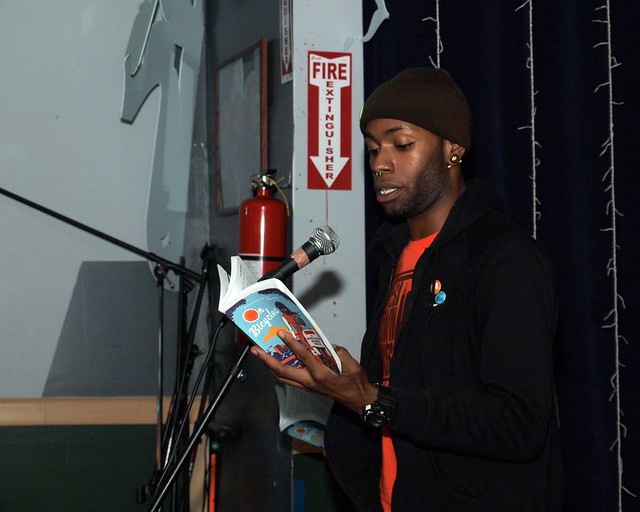
West Town Bikes’ Damian Lee reads from the chapter about the center at the Chicago release party for the book last month at Cole’s in Logan Square – photo by Serge Lubomudrov
John Pucher, a professor at Rutgers University, praised Chicago’s bike rack installment program and the bike station in Millennium Park. Chicago’s supply of bike-parking spaces of 1,121 per 100,000 residents outnumbers most American cities. Portland has 725, San Francisco 466, and New York a measly 75. But they are all measly compared to Amsterdam’s 30,271 and Copenhagen’s 6,960.
However, Chicago lags behind when it comes to bike routes physically separated from motor vehicles, with just two kilometers per 100,000 residents. San Francisco has six and New York three. Once again American cities are quite pitiful compared to Europe. Copenhagen has a staggering 76, Amsterdam 61 and Berlin 33.
Borzo’s thorough article on bike-sharing programs around the world lists a handful of entities in Chicago that offer bike sharing to their employees, tenants and students: the Field Museum, SRAM, the Willis Tower (formerly the Sears Tower), Argonne National Laboratory, the University of Chicago, Saint Xavier University and Loyola University.
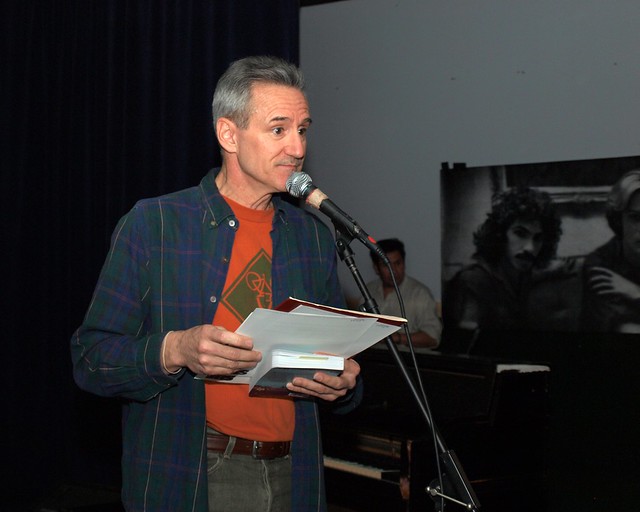
Borzo at the reading, which was followed by a Hall & Oates-themed dance party – photo by Serge Lubomudrov
An article on traveling with a bicycle by Shawn Granton gave a brief description of cycling in seven American and Canadian cities. Here’s what he said about Chicago: “The traffic can be intimidating, but there are scads of bike routes and fun settings of postindustrial decay. And it’s flat.”
The only other mention Chicago receives came in a highly entertaining semi-rant on freak bikes by Megulon-5. He traces the manufacture of tall bikes back to the late 1800s in Chicago. They were built for lamplighters to ride to turn streetlights on and off.
The book is mostly a positive screed extolling the virtues of the bike, though there is a certain amount of anti-car rhetoric. Lori Kessler, an architect, in a piece on designing cities for bikes wrote, “Hell isn’t other people, as Jean-Paul Sartre suggested. Hell is other people’s cars.” Another article quoted an American Automobile Association statistic that Americans spend on average $9,641 each year on their cars. Other authors cited the tons and tons of pollutants cars spew. One of the wilder statistics was the amount of space it would take to park all the cars in America–about the size of New Hampshire.
But the gloom and doom of the automobile are countered with one affirmation after another for the bicycle, none stronger than Mykle Hasen, the enchanted unicorn, stating, “Like a hammer or a telescope, the bicycle gives you superpowers.” Carmen Mills, a “bicycle bodhisattva,” is equally fervent. She says, “Bicycles are karma-generating machines, relieving suffering for self and others.”
This fall the Chicago Department of Transportation (CDOT) used a shock-and-awe strategy to raise awareness of pedestrian safety issues. As part of its $495,000 “It’s Up To You” safety campaign, funded by a grant from the National Highway Traffic Safety Administration, CDOT placed scary ads on trash receptacles and buses, illustrating the devastating effects of reckless driving. The department also installed 32 dead-white mannequins along Wacker Drive representing Chicagoans killed by cars last year.
CDOT’s latest ped safety initiative is also in-your-face, but in a kinder, gentler way. On December 8 the department zip-tied canisters of blaze-orange safety flags to poles at ten uncontrolled (no stoplight or stop sign) intersections near senior centers, schools and hospitals all over town. Since state law requires cars to stop for pedestrians in a crosswalk, you’re supposed to grab a flag, wave it to signal drivers to stop, cross the street and leave the pennant in the container on the other side.
On the Monday three days after the flags were installed, I visited locations around the city to find out whether people were actually using the flags, or just stealing them.