Strategies in the Pedestrian Plan: Skinny streets

[flickr]photo:6864053991[/flickr]

This rough drawing shows what could be done with the extra space if Haddon Avenue was narrowed and remained one-way. It doesn’t show what the street would look like if it were two-way. The drawing shows two scenarios with features that use the land reclaimed from asphalt: the first shows a cycle track. A speed limit sign says “neighborhood speed limit” (a number is left off so residents decide what speed is appropriate for their street). The second scenario has a rain garden in the land reclaimed from asphalt, to help with stormwater management. Both scenarios have permeable pavers in the parking lanes. 

The first-ever Chicago Pedestrian Plan will be introducing a lot of new concepts and ideas to Chicagoans (and even this transportation planner) about how to make the pedestrian experience safer, more comfortable, as well as more enjoyable. This post will be one of the occasional articles on strategies in the Pedestrian Plan.

Tool: Skinny streets, page 29

What it says: “After the severe winters of 1978 and 1979, many of Chicago’s streets were converted from two-way to one-way to improve mobility during the winter and to allow plows to go through. However, two-way streets have many advantages over one-way streets. These ‘skinny streets’ reduce vehicle speeds and can also increase connectivity for all users by providing more ways to traverse the city’s grid. Skinny streets should be considered on all one-way streets that are wider than 30 feet.”

Download the Chicago Pedestrian Plan in .pdf format: 15 MB or 100 MB. No web version available.

Continue reading Strategies in the Pedestrian Plan: Skinny streets
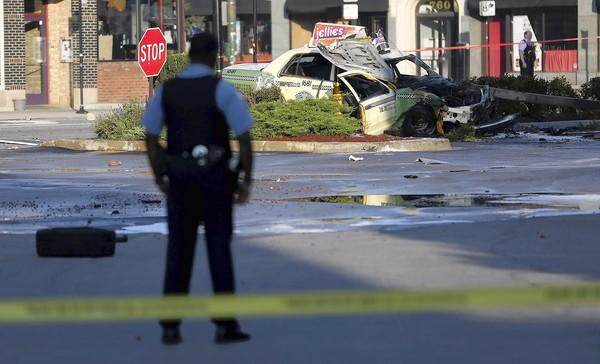
Update on cab crash that killed Eric Kerestes

[flickr]photo:6119129825[/flickr]

Kerestes was likely near the advertising bench underneath the CVS and bank sign. 

There’s a significant update in the story of cabdriver John Kesse, his manic driving, and the death of Eric Kerestes, on his way to work. Kesse was arrested Monday for reckless homicide; bail has been set at $200,000. Congregants at a church Kesse helped found in Lincoln Square plan to raise the 10% needed to release Kesse from jail.

The driving situation was wild and obscene:

Kesse had just picked up a fare in his Checker cab about 6 a.m. on Aug. 14 when he accelerated south on Milwaukee Avenue, weaving in and out of traffic and “driving into the oncoming traffic lane to pass the cars in front of him,” Assistant State’s Atty. Sylvie Manaster said in court.

Kesse blew through red lights at Noble Street and then Chicago Avenue, Manaster said. His cab then jumped a curb near the entrance to the Chicago Avenue Blue Line stop and knocked down two light poles before veering across Milwaukee and Ogden Avenues and striking Eric Kerestes, a University of Chicago MBA student who was waiting to catch a bus for work, Manaster said.

Kerestes, 30, was thrown more than 200 feet and pronounced dead at the scene, the prosecutor said. The taxi passenger, Michael Kim, 28, suffered a fractured spine and a bruised lung, she said.

Witnesses told police the cab was traveling at least 60 mph, double the speed limit, before it crashed.

We appreciate that the Cook County State’s Attorney’s office seems to be taking this case seriously. Kerestes’s wife is suing the City of Chicago, the cabdriver, and Checker Cab, for wrongful death.

There does seem to be missing information: there is no bus stop at Milwaukee/Ogden, at any corner. And especially not under the CVS sign, which is where some reports say Kerestes was sitting. There is a bench at the northeast corner of Milwaukee/Ogden, in the northbound Milwaukee Avenue direction, under the CVS sign. But this is not for a bus stop, for advertising only. If Kerestes was waiting for a bus, which bus route was he waiting for, and at which corner? There is only one CTA bus stop bench at this six-way intersection, for the westbound 66 Chicago bus on Chicago Avenue between Milwaukee and Ogden Avenues.

Chicago’s first pedestrian plan includes great ideas, lacks some information

[flickr]photo:7966249572[/flickr]

A press conference was held last Thursday at the southeast corner of Dearborn Street and Madison Street to announce the city’s first pedestrian plan. Present were commissioners of transportation and public health, Gabe Klein, and Bechara Choucair, respectively, Metropolitan Planning Council vice president Peter Skosey, and various CDOT staff.

After 20 minutes of speeches from Klein, Choucair, Skosey, and Active Transportation Alliance director Ron Burke, CDOT pedestrian program coordinator Suzanne Carlson and Klein applied a diamond shaped decal to a sidewalk corner across Madison Street. The bright yellow “sticker on the street” says, “Be Alert. Be Safe. We’re all pedestrians.” It’s part of the Pedestrian Safety Campaign launched last year that also included 32 mannequins scattered around Wacker Drive and then to other sites, as well as orange flags at certain crosswalks, and a somewhat grotesque ad campaign on trash bins and buses.

The Pedestrian Plan has its merits and faults. The document is nicely designed, easy to read, informative (it does a great job introducing people to “pedestrian safety tools” that are mentioned later in the plan), but still speaks to the car-centric profession of traffic (transportation) engineering exhibited in Chicago. Continue reading Chicago’s first pedestrian plan includes great ideas, lacks some information

Fatality Tracker: Hit-and-run of pedestrian on Damen overpass, but charges filed

2012 Chicago fatality stats*:

Pedestrian: 19 (9 have been hit-and-run crashes)
Pedalcyclist: 4 (1 is a hit-and-run crash)
Transit: 6

Robert Butler, a 51-year-old resident of Bellwood, Illinois, was killed in a traffic crash on Friday, September 7, at 4:30 AM, on the Damen Avenue overpass of the Stevenson Expressway. He was a pedestrian in probably the least-pedestrian friendly area in the region. The driver and his passenger were arrested; the driver, Anthony Castillo, 23, was apprehended less than a mile away in the McKinley Park neighborhood and charged with:

  • Reckless Homicide-Motor Vehicle
  • Leaving the Scene of an Accident w/Injury or Death
  • Possession of Controlled Substance
  • Failure to Reduce Speed

The passenger was charged with misdemeanor possession of cannabis. This story was originally reported by the Chicago Tribune. See a Google Street View image of the crash location after the jump, and more information on this type of highway intersection.  Continue reading Fatality Tracker: Hit-and-run of pedestrian on Damen overpass, but charges filed

Grid Shots: In the Loop

[flickr]photo:7965464222[/flickr]

A cyclist crosses State Street under the Lake Street ‘L’. Photo by Michelle Stenzel. 

It seems this theme could mean two things, traveling to or within the central business district of Chicago, or knowing what’s going on. We’ll go with the former.

[flickr]photo:7830838870[/flickr]

Two people converse on the corner of Randolph Street and State Street. Photo by Ann Fisher. Continue reading Grid Shots: In the Loop

Tribune comes out against CTA’s aisle-facing seating in a funny way

[flickr]photo:7924999848[/flickr]

On the first page of the Chicago Tribune on August 27 was a story about aisle-facing seating on the new Chicago Transit Authority’s 5000-series cars and how many people were unhappy with the setup. It was a case of inventing a story.

Then in the Sunday paper, on the “Chicago Week” page where the newspaper recaps a variety of stories it published since the previous Sunday, it summarized the story with the following:

Hey, can you move over a bit?

Not everyone’s happy with the CTA’s new rail cars and their aisle-facing seats, but the cars are likely here to stay. The transit agency spent $1.14 billion on the cars and reconfiguring the seats would require a major and expensive redesign. Riders have complained about having to ride with fellow commuters squeezed in on both sides and other passengers standing directly in front of them.

The photo included with the summary, embedded at the top, shows a majority of people (who are sitting) preoccupied with books and phones. One person sitting is giving the foreground standee the stink eye. This is hardly the photo to use to communicate the dislike that passengers have for the setup. 

Continue reading Tribune comes out against CTA’s aisle-facing seating in a funny way