New CTA buses and mid-life overhaul of more than 1,000 vehicles will avoid dismal situation 6 years ago

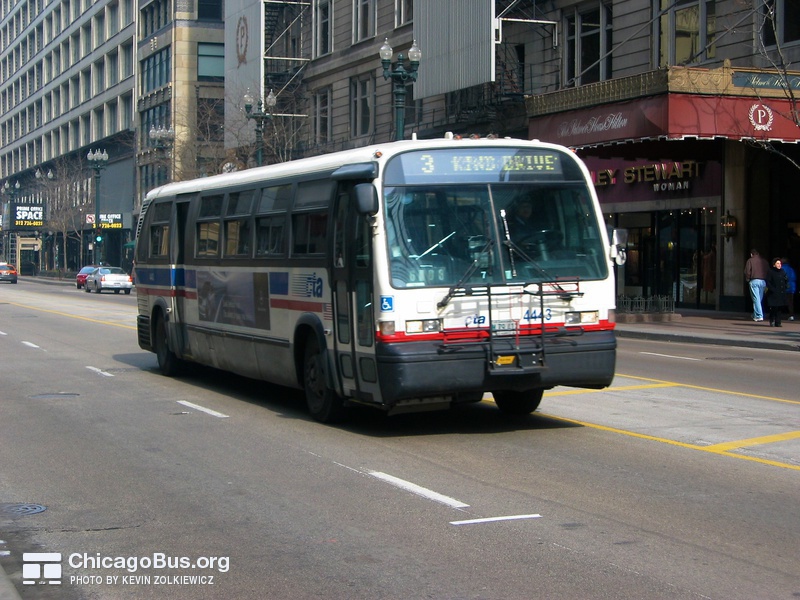
A 4400-series TMC RTS bus on State Street. Photo by Kevin Zolkiwicz.

I arrived in Chicago in 2006 to attend the University of Illinois at Chicago for a sociology and urban planning degree. I visited home in Batavia, Illinois, quite often. I took route 60-Blue Island/26th from campus to Northwestern Station to catch the Union Pacific-West line to Geneva. I distinctly remember how decrepit these buses were (this route seemed to have the oldest ones in the fleet, 4400-series TMC RTS). They lumbered; they were dark inside; they had stairs to climb aboard; passengers who wanted or needed to use the ramp had to spend several minutes waiting for the ramp to deploy and then be elevated.* I don’t know how much was just old design, no upgrades being made, or broken down equipment.

That was at a time of major service cuts, fare hikes, and deliberations about new legislation determining how to fund the Regional Transportation Authority and the three service boards it oversees (Chicago Transit Authority, Metra, and Pace).

The Chicago Transit Authority made announcements this year that should ensure this won’t happen again. Continue reading New CTA buses and mid-life overhaul of more than 1,000 vehicles will avoid dismal situation 6 years ago

Fall bike lane construction update

[flickr]photo:8182396466[/flickr]

A Marking Specialists work truck in the Marshall Boulevard bike lane it just helped create (they work on weekends, too!). 

Chicago Department of Transportation staff and its contractor Marking Specialists have been busy this summer and fall, striping miles of conventional, buffered, and separated bike lanes in Chicago. This post documents all of the new bike lanes we haven’t yet featured prominently, some of which are likely still under construction as the photos were taken between 1 and 4 weeks ago.

Sacramento Boulevard, 24th Boulevard, Marshall Boulevard

Still to come on this project through Little Village, Lawndale, North Lawndale: Douglas, Independence, and Hamlin Boulevards. It connects with a short, separated bike lane on Jackson Boulevard between Independence Boulevard and Central Park Avenue. The Central Park Avenue bike lane then connects north to separated bike lanes on Lake Street and Franklin Boulevard. Collectively these bike lanes are called “West Side Boulevards”. I like how this new separated bike lane “goes places”: through and to residential neighborhoods, past schools and parks.

People parked their cars in the bike lane, which we’ve found to be typical for under-construction separated bike lanes. The pavement quality issues that Franklin Boulevard suffers from are present on this project as well, in multiple locations (there’s a small bush growing in the bike lane a few feet before your reach a large pothole). I look forward to seeing the ultimate design created at the intersections and high-speed curves in Douglas Park and the pavement issues corrected. This project is likely still under construction.

[flickr]photo:8182355507[/flickr]

A separated bike lane on Marshall Boulevard, looking south at a Pink Line viaduct. It’s parking-protected in some locations. In this photo, new parking spaces are created where none previously existed.  Continue reading Fall bike lane construction update

Fatality Tracker: 44-year-old pedestrian killed in hit-and-run crash in West Rogers Park

Tsering Dorjee, 44, seen here with his youngest son
Tsering Dorjee. Photo by Bill’s Digital Photos.

2012 Chicago fatality stats*:

Pedestrian: 23 (12 have been hit-and-run crashes)
Pedalcyclist: 6 (1 is a hit-and-run crash)
Transit: 8 (our last update listed 7)
Skateboard: 1 (1 is a hit-and-run crash)

Update November 17, 09:30: The driver turned himself in on Thursday. Fernando Jasso Perez, 23, has never had a driver’s license. “Cook County Judge Donald Panarese Jr. set bail at $750,000 for Perez, who was charged with reckless homicide and failure to report the crash” (source). The Chicago Sun-Times published an editorial Friday urging state legislators to create a visitor drivers license for illegal immigrants. One of the benefits they espoused? “Police officers making a stop would know who is driving the car. With the threat of deportation lessened, illegal immigrants would have less of a motivation to leave the scene of an accident.”

Tsering Dorjee, a 44-year-old Tibetan man from India, was killed in a fatal hit-and-run crash on Monday around 6 PM in the 6400 block of N Maplewood Avenue in West Rogers Park and police are still looking for the driver, according to the Chicago Tribune.

Dorjee worked in the Cook County Clerk’s office and was the president of the Rogers Park Chamber of Commerce.

“It’s very distressing and very disappointing because, in our community, we have very few deaths but they are natural – sickness or old age,” [Lhakpa] Tsering said [president of the Tibetan Alliance of Chicago]. “This is the first time a hit-and-run has taken a life in our community.’”

The car was described as a dark blue Volkswagen Beetle with the Illinois license plate P121817. Police asked anyone with information to call 312-745-4521.

Dorjee’s brother-in-law, Dakpa Jorden, 46, “was also injured in the collision and suffered a fractured neck and leg”, according to the Chicago Sun-Times.

* The information is only accurate as of this post’s publishing time. View previous Fatality Tracker posts.

Might as well Jump! The CTA debuts a stepping-stone to bus rapid transit

[flickr]photo:8180431198[/flickr]

I’d been looking forward to riding the new J14 Jeffery Jump bus service for a few weeks now. It was a chance to participate in a small but significant turning point in the history of the CTA. The Jump is a new express bus along Jeffery Boulevard (2000 East) on the South Side, incorporating several elements of bus rapid transit (BRT) and hopefully paving the way for full-blown BRT downtown, on Ashland Avenue and/or Western Avenue within a few years.

In a nutshell, BRT brings buses up to subway-like speed via special infrastructure on the existing roadway, at a fraction of the cost of creating new rail lines. Ideally, BRT includes dedicated bus lanes, center running buses, stations in the median where customers pre-pay before boarding, traffic signals that turn green when a bus approaches and other features.

The Jump, funded by an $11 million Federal Transportation Administration grant, is essentially BRT lite, but it’s definitely a step in the right direction. Dedicated bus lanes only exist on a portion of the sixteen-miles Jeffery route, a two-mile stretch from 67th to 83rd Streets, and only during rush hours. From 7 – 9 am weekdays, parking is banned on the east side of the street to accommodate inbound bus traffic, and vice versa for outbound buses during the evening commute from 4 – 6 pm.

Continue reading Might as well Jump! The CTA debuts a stepping-stone to bus rapid transit

Active Trans takes an active role in supporting the growth of green lanes

[flickr]photo:8166225024[/flickr]

Lee Crandell in the Kinzie Street protected bike lane. This photo and Jackson bike lane image are by John; all others are by Steven.

[This piece also runs on the website of the Green Lane Project, an initiative that is promoting protected and buffered bike lanes nationwide, sponsored by the national advocacy group Bikes Belong. The term “green lanes” refers to protected and buffered lanes and other innovative bikeways.]

After a lull earlier this fall, the Chicago Department of Transportation (CDOT) is moving full speed ahead expanding the city’s bikeway network. Mayor Rahm Emanuel has committed to building 150 miles of green lanes (110 miles protected and 40 miles buffered) by 2015. Earlier this year CDOT bikeway project director Mike Amsden told me he hoped to reach a total of thirty miles of green lanes before construction season ends this year.

The department recently striped several new stretches of buffered lanes on Chicago’s North, South and West sides. Crews are currently finishing a 1.3-mile section of protected lanes on 31st Street, as well as a continuous 3.5-mile network of protected lanes along the city’s historic boulevard system. Another ten miles of green lanes are still on the table for this fall, including a “game-changing” two-way protected lane on Dearborn Street through the heart of downtown. With the current flurry of activity it’s very possible CDOT will win its race against time.

Continue reading Active Trans takes an active role in supporting the growth of green lanes

In Obama’s second term, distinctive transportation policy must change focus to walking and bicycling

[flickr]photo:8163415218[/flickr]

Barack Obama and his family on stage at McCormick Place last night. Photo by John Tolva. 

President Obama was elected to a second term yesterday, defeating former Massachusetts Governor Mitt Romney. We are glad for this as we believe it will maintain the excellent ideas, initiatives, and enthusiasm for sustainable transportation for at least four more years. President Obama hired Ray LaHood to be the secretary of transportation. Partnering with the Department of Housing and Urban Development (HUD) and the Environmental Protection Agency, the U.S. Department of Transportation crafted six livability principles that changed how grants would be distributed.

[flickr]photo:5779547634[/flickr]

This Amtrak Lincoln Service train will be moving a bit faster this year. Photo by Eric Pancer. 

The Obama administration created the first-ever plan for high-speed rail corridors and after Congress passed the American Recovery and Reinvestment Act (ARRA, “stimulus”) in 2009, Illinois rebuilt hundreds of miles of track from Chicago to St. Louis, Missouri, to speed up its busiest passenger train line. The plan is the best chance for European and Asian-style high-speed rail to connect Midwest cities, giving people more options and alternatives over driving with expensive gas and unfairly-subsidized roads.

Continue reading In Obama’s second term, distinctive transportation policy must change focus to walking and bicycling