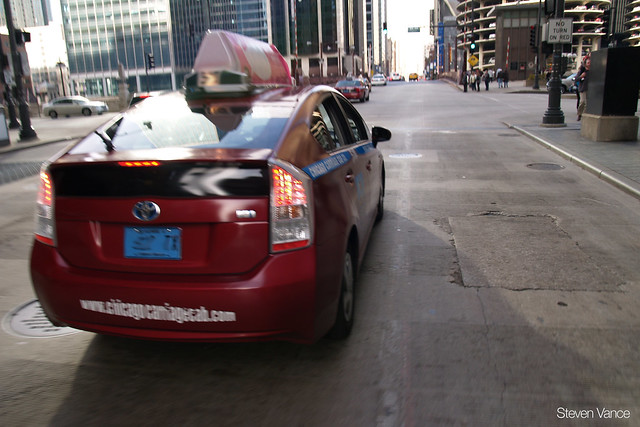
The taxi driven by the man who harassed me and against whom I testified in an administrative hearing.
This is the story of my being harassed by a taxi driver while cycling in downtown Chicago the day before Thanksgiving in November 2011. I was riding from Grant Park to meet my mother and sister for lunch at Xoco (449 N Clark). It’s also a set of loose instructions on curbing car culture.
The article is divided into three sections: the incident, the hearing, and the results. I am not revealing the taxi driver’s name or cab number: he’s already had his hearing and received due process; additionally, he may not always drive the same cab number. On the day of the incident, November 25, 2011, he leased his cab from the Chicago Carriage Cab Corp.
If you feel unsafe from the behaviors of a taxi driver, call 311 immediately after composing yourself and ask to file a complaint against a taxicab driver. You must have the time, location, and taxi number. If your immediate safety is threatened, call 911 first.
Incident
This is the description I submitted to the Chicago Department of Business Affairs and Consumer Protection, who regulate public chauffeurs.
SR# 11-04169237 [this is the tracking number for calls to 311]
Date of incident: November 25, 2011
Time of incident: 1:24 PM (1324h)
Cab number: [redacted]
Amount on meter at destination: Did not hire cab
Amount paid: Did not hire cab
Number of passengers: Did not hire cab
Address of pick-up: Did not hire cab
Address of destination: Did not hire cab
Address of incident: Northbound lanes of Dearborn Street between Lake Street and the stop bar south of Wacker Drive
If known, describe/write the cab driver’s physical description, and/or license number:
Driver was black/African-American, male. See attached photo of the driver.
Please describe in detail exactly what happened:
Summary:
Driver passed recklessly close to me while I was riding a bicycle, within 12 inches, which is so close that I could have reached out and touched the car.
Detail:
The driver honked at me (see marker A on the attached map) when I was in the right-most lane on northbound Dearborn Street 50-100 feet north of Lake Street (a violation of Illinois Public Act 096-1007). Then the driver passed recklessly close to me (within 12 inches) 50-100 feet after the honk (see marker B). Then the driver stopped his car 50-100 feet after the pass (see marker C). He stated, rather, he yelled, that I cannot ride in the middle of a lane (“you can’t take up the whole lane”, he said) – I did not stop when he stopped, but continued riding north. Driver stated that I must ride in the bike lane and not in the middle of the lane. Please note that Dearborn south of Wacker Drive has no bike lane.
The driver repeated the close pass 50-100 feet after his first stop (see marker D). The driver stopped again 50-100 feet after the pass, where we conversed (see marker E). In our conversation, he made his statement again about how I cannot take up the whole lane. I replied, “Yes, I am allowed to [take the lane], you should read the ‘Rules of the Road'”. I was referring to the “Rules of the Road” booklet that the Illinois Secretary of State publishes (see page 39 in the 2011 edition, where it says, “However, certain hazards such as rough surfaces, debris, drainage grates or a narrow traffic lane [my emphasis] may require bike riders to move toward the center of the lane.”).
It is in my opinion that the driver was very close to deliberately causing injury or damage to me or my bicycle, respectively, by unnecessarily honking (and not to warn of an impending collision, but for harassment purposes), by passing recklessly close, and by having an insufficient knowledge of the rules of the road.
Hearing
The following text is adapted from my hand-recorded chronology of events that transpired during the hearing on Tuesday, May 22, six months after the incident. Text in block quotes is a near-verbatim (written) recollection of what was spoken.
It’s 9:23 and I’m sitting on a bench in hearing room 106 at the Chicago Central Hearing Facility at 400 W Superior.
A taxi driver is sitting behind and to my left on another bench. There are five benches in this room. The room is larger than it appears: it’s about 20 feet wide and 40 feet long. Two podiums face the hearing judge.
The hearing judge is Robert Soelter. There was a different hearing judge, Sharon Johnson, when I first entered the room at 9:05, a few minutes late for the hearing scheduled at 9:00.
I talked to an attorney for the City of Chicago from 9:10 to 9:23, in a small, closed anteroom. I described the incident to him. While I described the incident in a lot of detail (to him and in the affidavit), it was my goal to be objective and leave emotion out of it. The incident may have violated my feelings, safety, and level of comfort cycling in mixed traffic, it was clear that the taxi driver violated several laws and his driving posed a physical threat to me.
But maybe emotions help win cases – I’ve no idea and this was the first time I’ve been involved in a court case or administrative hearing.
The attorney, Matthew, asked me if I knew which laws in the Illinois Vehicle Code applied to the incident. I’m not as familiar with the Illinois Vehicle Code as I am with the Municipal Code of Chicago. In the affidavit I submitted to the City (specifically the Department of Business Affairs and Consumer Protection), I did list one Illinois Vehicle Code identifier.
I showed him the Chicago Bicycle Program’s Chicago Bike Laws website that I built with content assistance from another staffer (I also revealed to him that I created it).
The attorney proposed to me a settlement between his client, the city, and the driver. The settlement would mean mandatory retraining, a drug test, physical, and a fee. I don’t agree with requiring the driver having to take a drug test or physical as the incident happened six months ago; I didn’t express my disagreement.
At 9:29 the attorney says we’ll get started in five minutes and suggests to the taxi driver that now’s a good time for the driver to feed the meter.
The driver is representing himself. Matthew advised me to be cool headed. He said it’s very easy for the hearing judge to imagine the reckless cyclist.
9:35. “Good morning, judge”. “Good morning, counsel”.
The judge describes to the taxi driver (the defendant) that the attorney will make the case in chief to establish a prima facie case. This means providing enough evidence that the judge feels “there’s a case here and that it will continue”.
If prima facie is established, then the defendant can present his case in chief. The defendant will in all situations be able to cross examine evidence and witnesses. The judge’s decision is based on a preponderance of evidence (which way does it swing). The judge doesn’t represent any party.
At 10:06, prima facie is established and it’s the taxi driver’s turn to establish his case.
Driver: I felt he was cycling unsafe and I had to convince him to ride on the right side. I’ve had no violations in six years [this turned out not to be true].
The driver said I gave him the middle finger and that I was in a dangerous position.
I was sending him a signal about being in a dangerous position, not trying to give him a hard time. I was warning him. I couldn’t merge left. Taking my picture is illegal [false]. You don’t have the right to take my picture. He was in front of me at Hubbard and Dearborn [false]. I can’t behave like that with a passenger. This isn’t the first time he complained against a taxi driver.
The driver then implies I blew a red light. He later says that I blew the lights at Wacker, Kinzie, Hubbard, and Grand, all while giving him the middle finger.
The judge and the defendant have several minutes of awkward “conversation” about the specifics of the interaction between the defendant and I. This is likely based on the defendant’s limited ability with understanding and speaking English (which the defendant brings up at least once).
He moved ahead of me and never stopped. Freestyle, no hands, listening to music [all false]. All I want is to share this street. We don’t know each other.
At this point, 10:23 AM, I heard enough of these lies and I waved my hand for more than a minute, to get the judge’s attention. The judge finally sees me and says, “It seems the City’s witness wants to say something”.
I reply, very anxiously, “Yes, I would like to say a few things”. Matthew seems caught off guard by this; it’s probably not within protocol for the hearing. He and I step into the hallway so I can tell him that all of the driver’s accusations about how I was cycling that day were false. I then tell him that he can catch the driver in a lie by pointing out in the photograph I submitted to the lit toplight on the cab. This would indicate the meter wasn’t running and that he didn’t have a passenger.
We return to the hearing room. The attorney asks me if I was riding with music or without hands and I reply that I was riding without music and with both hands on my handlebars except for the two moments during which I took photos of the defendant and his taxi, which I submitted to the City in my affidavit.
Matthew gives his closing argument at 10:26, saying “my witness has the far more credible story”:
Mr. Vance’s testimony was consistent and detailed. The respondent has differing and conflicting testimony.
The attorney then brings up how the toplight was on.
This tilts the preponderance of evidence in our favor. The turn of events is clearly obstruction and violation of [public chauffeur license rules] 5.08.A and 5.08.B [unsafe passing, unsafe stopping and being misinformed about traffic rules].
It’s now 10:29 and the respondent’s turn to make a closing argument. He describes why his toplight was on:
My car has an electrical problem. My toplight will be on with the meter running. Some cars have this opposite problem. There’s a lot of cars like this.
I had a conversation over Twitter on Saturday about this issue with the well-known cab driver Dmitry Samarov, who published a book recently called Hack: Stories from a Chicago Cab. I went to his book reading at Whistler earlier this year. Samarov responded to my inquiry: “Too common unfortunately. There’s a wire that burns out in the meter. When you engage the meter, the toplight should turn off.”
When it seems like the defendant has finished his closing argument, the judge says he’s going to close the hearing; he reiterates the physical and oral evidence. He then makes two findings. The first is that using the horn, passing close, and stopping in front of me made for unsafe driving consistent with rule 5.08.B.
It’s not your job to advise other motorists, be they bicyclists, drivers or cars or trucks. You should leave the area if they cause you concern, not instruct them. I don’t have the sense that 5.08.A was supported. That rule relates to the treatment of passengers. The driver is not liable for a violation of 5.08.A.
The judge asks the City, “What are your recommendations?”
Matthew describes that public chauffeur license rules call for a $200-$1000 fine for repeated offenses and offers the City’s recommendation:
On one other occasion, driver has been liable for a complaint in 2006, which falls within the 5-year window, and he plead liable to discourtesy. I ask for a fine of $250 on each count [there were originally three counts and two were sustained].
Results
The judge exclaims, “So found” adding that there the fines total $500 plus $40 in court costs. “For the record, you have the opportunity to file an appeal within 35 days at the Daley Center”.
In a debriefing with Matthew, he tells me that the driver will have to go to school to take an 8 hour class on safe driving and an 8 hour class on courteous conduct. I was pleased with the results at this time.
I am at odds with myself over the level of fines the driver has to incur after this incident and hearing. I think the fines may be a little too much for this incident, but only because I wasn’t injured. But a different cyclist in the same situation, or myself in a slightly different situation could have had a different, more injurious impact. And public chauffeurs are held to a higher standard.
I think the education will have a greater affect on the driver’s behavior towards cyclists in the future than the fine.
My desire in publishing this story has myriad goals:
- I want others to know how the process of filing a complaint against a taxicab driver works.
- I want to motivate others to complete the complaint process and follow through in every way that the City requests and that is possible for you.
- To understand how the hearing process works.
- To demonstrate that it’s possible for bad drivers to receive punishment and that there’s such a thing as citizen traffic enforcement. I want this mechanism to work for any licensed user of the road.
- Advise people to carry a camera, or have it ready to shoot.
Something I didn’t expect is that the driver is being brought to this hearing, which occurred because he contested it, for violations of his public chauffeur license, and not his violations of Illinois or Chicago traffic laws. But violating traffic laws is a violation of certain provisions in the public chauffeur license, which you can download (pdf).
Rules
Rule 5.08. Discourtesy; Assault, Abusive Behavior; Operating Under the Influence; Reckless Driving.
- 5.08.A: Chauffeurs shall be courteous to passengers, prospective passengers, and other drivers at all times.
- 5.08.B: Chauffeurs shall not assault, threaten, abuse, insult, provoke, interfere with, impede, obstruct, or use profane language or obscene gestures around any person in connection with the operation of their vehicles.
Thank you for this detailed account, and for pursuing your case.
You’re welcome. I hope this story encourages others to take action. It all starts with a simple phone call.
thanks for sharing.
You’re welcome. Thank you for reading.
This is great! Thanks for doing this and sharing. I believe that, unfortunately, most of the cab drivers pose a serious danger to passengers, other vehicles, cyclists and pedestrians.
I often hear similar concerns: taxi drivers are endangering other road users. I wish there was a way to prove that they did so at a higher or lower proportion to drivers of other types of vehicles (private passenger, semi trucks, buses, etc.) but the data doesn’t exist on how much and where each person drives.
In any case, this shows that there’s recourse for bad taxi drivers that doesn’t involve the police.
Thank you for posting this informative experience.
You’re welcome. I was elated when I got the letter saying that my complaint was going places. I would have canceled a vacation to make that court hearing (actually I would have asked for it to be rescheduled ;).
this type of harassment is all too common. i don’t think his fines were too steep, hopefully it’ll be a deterrent for this type of behavior. i also called 311 when this happened to me (someone driving their personal car), but nothing could be done because a) i wasn’t physically hurt and b) i was no longer at the scene. so even though i had her license plate #, i wasn’t able to get the police to write a ticket for passing too close. maybe if i took a picture, they would’ve made an exception for reporting it after i left the scene.
Interesting, my wife was hit by a driver, and went to the hospital. The driver hit her out of road rage, evidenced by swearing and excessive honking. The city fined him $50 for failure to yield, even though he had no insurance, and didn’t have a drivers license on him. I was surprised to hear the big fine with this situation, based on our experience with the “justice” system.
I have no idea how far you’re willing to go, or if this is even possible, but I think you could sue the police department or even the state’s attorney into issuing more appropriate fines. The lack of insurance is an objective and evidential description that I presume was documented by the responding police officer.
We’re done with it. We had to go back to court several times because the guy that hit my wife kept “forgetting” his paperwork. They were sweet as pie to him and said “we’ll just reschedule for a month or two from now so you can get everything in order.” It was like a giant practical joke on us. We have no interest in seeing another court room, ever.
also i like how part of the taxi driver’s defense for harassing you was that you were harassing him by cursing. it’s like justifying running a red light, because the guy next to you ran a red light, too.
i only wish there was a way for drivers to do the same in the case of byciclists running red lights, going against the trafic on a one way, going in between the lanes between two stoped cars at the trafic lights…and many other instances where byciclists dont respect the low.there are so many of this incidents and noone seems to care about that…just think about how many times this happens. i am not saying it was right what your cab driver did…i am just saying sometimes the byciclists are not at their best behaviour either and noone can do anything about that and police does not care either.if the driver wouldn’t have been a cab driver you couldnt have done anything about it…but because he was a cabie…
We hold can drivers to a higher standard. Is that right, though, as they hardly make up the majority of cars on the road? A group of people is in charge of policing traffic violations, be they committed by people driving or bicycling. But the police department polices neither.
In this case, the city department that issues the special taxi license, polices those drivers.
I am a Chicago Police officer and an avid cyclist. I can assure you that many of us, including me, take traffic safety and the safety of cyclists and pedestrian very seriously. I cite cab drivers and other motorists every day. The administrative hearing process (as opposed to the joke that it Traffic Court) is an excellent means to address reckless cab drivers, and it sounds like your experience bears proof to that. And I have found that the city attorneys that handle the administrative hearing process do a very good job with the limited resources and support given to them by the City. And I thank you for taking your own time to help address another dangerous and aggressive driver.
Thank you for commenting. I was speaking hyperbolically; I know the police are enforcing traffic laws, but it just seems so rare to me that it’s close to nothing.
This is a tough one, because some of the bike riders in this city are just as bad as some of the cabdrivers. Just different vehicles.
Of course there are good cab drivers and bikers too. But for some reason, after reading this, I’m willing to bet that if I was there watching the actual incident, I bet you both probably did stuff to instigate it.
Which road vehicle (err, law says bikes are devices) is more harmful?
i have mixed views. full disclosure i use to be a cab driver but i dont feel what that driver did was right. the problem i have is with the corruption that exist between the cab companies and the city of chicago, which is never addressed. cab drivers are making on avg minimum wage and it is borderline a slave institution. but people like you get their gratification not from correcting an injustice but prosecuting people that have emotionally offended you. why dont ilyou and your readers take time out an investigate the chi cab industry in chicago? corruption and greeds by product is the general service you experience with chi cab drivers. but your not just like your not going to do anything bout the crime that effects nonWHite lower class chicagoans. you and readers grafication is that you smuggly sit in ur uppie neighborhoods and ignore it all.
I wouldn’t call “at risk of being in a crash with a non-understanding taxi driver” being “emotionally offended”. I call it driving dangerously and illegally.
This morning cab no. 935 of cab company Flash got rude with doorman of the westin River North hotel because we told him to wait in the cab lane on dearborn at and he got angry.please we don’t want this cab in our property..
Call 311 to report it.
I had an incident this morning. A Chicago Carriage Cab #5760 honked and drove past dangerously close to me. Thanks for the post! I will call 311 immediately.
Keep me updated