Not every bike lane is cause for a celebration

[flickr]photo:7674354680[/flickr]

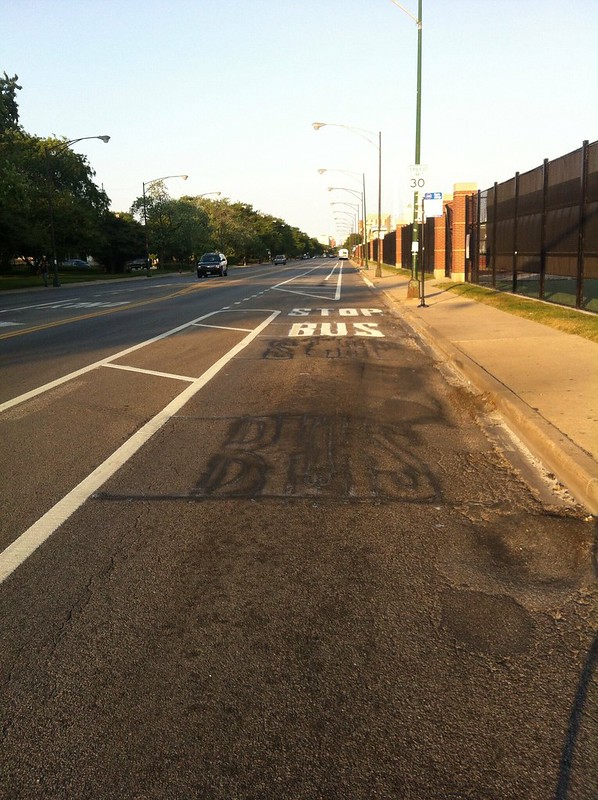
The Grand Avenue bike lane is less than 2 years old and came with destroyed pavement. This photo was taken between Clark and LaSalle Streets. 

The addition of a bike lane on any given street is not necessarily a victory for citizen cyclists. In order to to be a worthy expansion of the cycling network, bike lanes should be installed (with appropriate contextual modifications) on streets where such an addition makes the roadway more conducive to comfortable cycling. Grand Avenue isn’t one of these streets. The addition of a bike lane between Orleans Street and Navy Pier in 2010, when no other changes were made to the street environment and design, did not make the street better to cycle on. There were preexisting issues that have remained long after the lane was striped.

[flickr]photo:7674363046[/flickr]

A right-turn lane would likely have fit at LaSalle Street, but instead drivers use the bike lane to prepare for their turn.  Continue reading Not every bike lane is cause for a celebration

The Maya Hirsch settlement will help save the lives of other Chicago children

[flickr]photo:3047886559[/flickr]

Maya Hirsch with her father, courtesy of the Stop for Maya foundation.

On Wednesday Chicago City Council approved a $3.25 million settlement with the family of Maya Hirsch, a four-year-old girl who was killed by a hit-and-run driver in Lincoln Park, possibly due to poorly placed signs and faded crosswalks. Under the Emanuel administration the city has ramped up its efforts to improve pedestrian safety, but the settlement highlights the need to continue these efforts, which will help prevent similar tragedies.

On the afternoon of May 20, 2006, after visiting the Lincoln Park Zoo, Maya and her mother and older brother were crossing the intersection of Belden Avenue and Lincoln Park West to catch a cab when Michael Roth, 57, driving northbound, ran the stop sign. Roth, who had worked as a driving instructor in the early 1980s, but had his driver’s license revoked for several years after two DUI convictions, had a valid license at the time of the crash.

Continue reading The Maya Hirsch settlement will help save the lives of other Chicago children

Logan Square designers are attempting to figure out if a crowd can fund a new CTA map

[flickr]photo:7559781940[/flickr]

This is the second story of two about the “Designing Chicago” launch party. See “Why do these people love the CTA?

Greater Good Studio of Logan Square intends to build a mobile app that will showcase a new map of the CTA. It will have some other features as well, but determining what those are will be left up to backers who help contribute to the app’s fundraising on Kickstarter. The studio is led by George Aye and his wife Sara Cantor Aye, two Chicago designers.

According to George, the CTA prints out 750,000 copies of its system map every year. “I want to make it smaller, easier, more usable on the go, for someone that’s not very familiar with it. I’ve talked to Dennis McClendon [the original designer of the current CTA map], and others who agree, that the map is more useful for people who’re somewhat experts on the system.”

The Ayes want to raise $125,000 via Kickstarter to create this app. And those who “back it” at a certain level are invited to become developers of the app. It’s crowd sourced funding, and crowd sourced design. Continue reading Logan Square designers are attempting to figure out if a crowd can fund a new CTA map

Construction of the 55th Street protected bike lane and road diet began Wednesday

55th PBL installation, Wednesday 27 June

The eastbound bike lane begins at this bus stop at Cottage Grove Avenue. 

Erik Swedlund shares these photos taken Wednesday and today of construction on 55th Street between Cottage Grove Avenue and Woodlawn Avenue.

Room for the cycle track is made possible by removing a travel lane in each direction. Elements of this project that are different from previous bike lane projects in Chicago are the mixed traffic areas for right-turn lanes and bus stops. Continue reading Construction of the 55th Street protected bike lane and road diet began Wednesday

Pier pressure: is there an alternative to the $45 million Navy Pier Flyover?

[flickr]photo:7458845842[/flickr]

Congestion on the Lakefront Trail at the Lake Shore Drive south bridge house leads to frustrating experiences, especially for those on wheels. 

The section of the Lakefront Trail between Randolph Street and Ohio Street Beach cannot comfortably handle the traffic present in the many congested areas around the Lake Shore Drive bridge, Navy Pier, and Jane Addams Memorial Park. The narrow width, awkward curves, and blind spots make for highly dissatisfied trail users, that includes the gamut of Chicagoans and visitors, using Segways, four-wheel pedal cars, skates, strollers, bicycles, wheelchairs, or their own feet. There’s not enough room for the number of people who pass through here. This section of the trail is used by individuals on work and social trips, as well as groups meandering from park to park along Lake Michigan. The City plans to build an elevated structure, called the Navy Pier Flyover, to bypass the congestion, but at an extreme cost. We propose a different project to meet the same goals of comfortable passage on the path with a much smaller price tag.

The main problem areas are at the north and south ends of the Lake Shore Drive bridge, on the sidewalk between the bridge and Grand Avenue, at the blind spot where the trail meets Grand at the corner of Lakepoint Tower’s parking garage, and in the congested area inside Jane Addams Memorial Park and Ohio Street Beach. The Navy Pier Flyover is a planned structure on the Lakefront Trail that will “fly over” these trouble spots. The Lakefront Trail path as it currently exists will remain open for those who don’t want to use the flyover. Additionally, an “off ramp” will be built from the overpass to Navy Pier alongside the Ogden Slip – this part is superfluous to addressing path congestion, but may be useful for some path users. The project does not sufficiently address congestion at Ohio Street Beach.

The Navy Pier Flyover is going to cost a jaw-dropping $45 million. To put this in perspective, in 2008 the Portland, Oregon, Bureau of Transportation estimated the entire replacement cost of its then 300-mile bike network at about $60 million. We propose an alternative solution to combat the same problems at a much lower cost, and with a far quicker construction time.

Continue reading Pier pressure: is there an alternative to the $45 million Navy Pier Flyover?
From safety to where? Discussing the future of safe streets at a CNU talk

[flickr]photo:7454454294[/flickr]

Rob Bielaski, Steven, Mark de la Vergne, Eric Dumbaugh.

By coincidence both Steven and I recently appeared on two different panels about sustainable transportation within a few days of each other. Last Thursday I was part of the talk “Chicago Cycling: What’s Next?” at the Peggy Notebaert Nature Museum in conjunction with their “Bikes! The Green Revolution” exhibit. Monday Steven participated in the discussion “Safe Streets,” hosted by the Congress for the New Urbanism (CNU) at the Jefferson Tap, 325 N. Jefferson in the West Loop. The panelists talked about what makes streets safe, and discussed new developments in Chicago street design.

Based in Chicago and headed my former Milwaukee mayor John Norquist, CNU is a nonprofit that promotes walkable, bikeable, transit-friendly, mixed-use development. Joining Steven on the panel, which doubled as CNU’s monthly happy hour, were Eric Dumbaugh, an associate professor at Florida Atlantic University who has authored more than forty books about transportation and urban planning, and Mark de la Vergne, a project manager at Sam Schwartz Engineering who has worked on Chicago’s pedestrian plan, the Streets for Cycling 2020 plan, and will be involved with siting and outreach for the city’s upcoming bike sharing program.

Continue reading From safety to where? Discussing the future of safe streets at a CNU talk