Does the new “tied arch” bridge on Halsted encourage speeding?

[flickr]photo:7303499664[/flickr]

Approaching the new bridge from the south. Here there are two travel lanes, bike lanes and parking lanes.

When new bridges are built in Chicago, the Illinois Department of Transportation (IDOT) generally requires that they be built to accommodate projected traffic demands. The assumption is that in the future there will be more people driving than ever before, although most of us hope this won’t be the case.

So when the Chicago Department of Transportation (CDOT) rebuilt the North Damen Avenue bridge over the Chicago River in 2002, IDOT insisted that the old two-lane bridge be replaced with a four-lane, although Damen is generally only a two-lane street. But as a rule, if you give Chicago drivers the opportunity to speed, they will.

So it shouldn’t have been a surprise that as soon as the new bridge opened, motorists took advantage of the new half mile of wide open space between stoplights at Fullerton and Diversey to put the pedal to the metal. The speeding cars, plus the fact that bike lanes weren’t included in the project, turned a formerly bikeable bridge on a recommended bike route into a hostile environment for cyclists.

Continue reading Does the new “tied arch” bridge on Halsted encourage speeding?
Bridges update: Halsted now fully open, Chicago Avenue to be reconstructed, one lawsuit settled so far

[flickr]photo:7140486281[/flickr]

Photo of the reconstructed Halsted Street bridge at Chicago Avenue (looking north) by Ian Freimuth. 

John’s interview with Lorena Cupcake on Monday generated some new chatter about open grate bridges on Twitter. We’ve written about the dangerous bridges several times before and called for them to be fixed, even offering to trade 25 miles of Mayor Emanuel’s 100 miles of protected bike lanes for 25 safe bridges. Since then I’ve heard nothing but support for the idea from people who want truly safe connections across the Chicago River even if it meant fewer cycle tracks and buffered bike lane – the sentiment is based largely on the desire to maintain and fix what exists, rather than build anew.

Halsted Street

You can now continuously ride (in the street, no sidewalk jumping necessary) on Halsted Street from Chicago Avenue to Division Street, over Goose Island. The bridge at Division Street was replaced and opened in December 2011, while the bridge at Chicago Avenue had its deck replaced (among other changes). On the edges, a concrete surface was made in a new bike lane to make the bridge more comfortable for cycling.

The pavement marking design on Halsted Street going northbound approaching Division Street uses the centered bike lane design we panned in the article, How Danes make right turns. The bike lane is in between a 10 feet and 11 feet wide travel lane, for about 500 feet, so cyclists will be passed by buses and trucks on both sides. For over 300 feet of the 500 feet section, the bike lane has only dashed lines, possibly reducing its overall visibility. This situation is found on several other streets around Chicago. Dan Ciskey told us, “I hate getting passed by people going 40 MPH on both sides of me on Roosevelt Road”. Roosevelt Road between State Street and Canal Street has a collection of different bike lane designs: There’s a centered bike lane in each direction for hundreds of feet, then the bike lane is shared (again in each direction) with an ambiguously marked bus lane for hundreds more feet.  Continue reading Bridges update: Halsted now fully open, Chicago Avenue to be reconstructed, one lawsuit settled so far

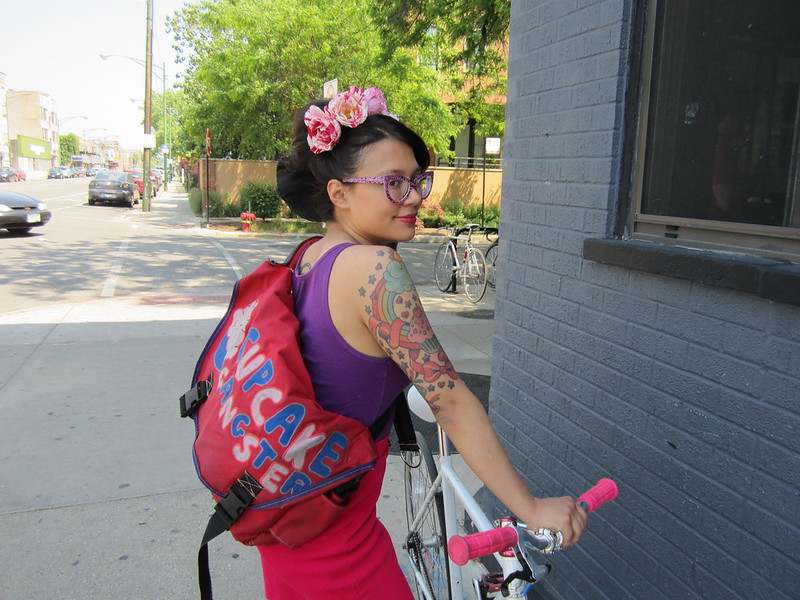
Gangster rap: an interview with bike style icon Lorena Cupcake

Lorena Cupcake

[This piece also appeared in Checkerboard City, John’s weekly transportation column in Newcity magazine, which hits the streets in print on Wednesday evenings.]

In a Midwestern town where folks dress conservatively, bike style icon Lorena Cupcake stands out like a handful of Skittles scattered across the Wall Street Journal. Easily spotted by her candy-colored outfits, rainbow-and-lollipops tattoo and messenger bag emblazoned “Cupcake Gangster,” she’s also an astute commentator on the local cycling, drinking and foodie scenes via her frequently updated, often hilarious Twitter feed.

But Cupcake, 25, is far from just a hipster gadfly. A frequent participant and volunteer at “alleycats,” underground, messenger-style checkpoint races, she runs the bike event Twitter calendar @chicagoholdup and helps stage the annual Bicycle Film Festival. Last year she and a few other petite fixed-gear enthusiasts formed Tiny Fix, a bike gang especially for women under 5’2”, which organizes bar nights, dance parties and now their first alleycat, last weekend’s Tiny Fix Ace Race.

I recently caught up with Cupcake, fresh off her day job as a bank teller, over $3 cheeseburgers at the Blue Frog, a messenger bar at 676 N. LaSalle in River North. She gave me the skinny on Tiny Fix, the upcoming race, and the things she loves and hates about biking in Chicago.

Continue reading Gangster rap: an interview with bike style icon Lorena Cupcake

CDOT unveils draft Streets for Cycling plan, but there’s still time for input

[flickr]photo:7263338490[/flickr]

On Tuesday at the first of several community input meetings before the Streets for Cycling 2020 plan is finalized, the Chicago Department of Transportation (CDOT) unveiled a draft map of locations for the 110 miles of protected bike lanes (PBLs) and 40 miles of buffered lanes to be built during Rahm Emanuel’s first term.

However, the meeting focused on a new concept, the Citywide 2020 Network, a comprehensive plan for 640 miles of bikeways to be created over the next eight years – more details on this in a minute. CDOT also unveiled a draft map of this larger network at the event, held at the Copernicus Center, 5216 W. Lawrence in Jefferson Park.

Although the Streets for Cycling community input process is nearly complete, there’s still time to provide feedback before the final plan is unveiled at the Bike to Work rally on Friday, June 15. After you finish reading this post, take some time to study the two maps. If you have suggested edits to the proposed bikeway locations, see the bottom of the post for several ways you can make your voice heard.

Continue reading CDOT unveils draft Streets for Cycling plan, but there’s still time for input

Lake Street protected bike lane construction began this morning

[flickr]photo:7243846640[/flickr]

Crews started constructing a protected bike lane this morning on Lake Street between Damen Avenue (connecting to an existing bike lane to the north) and Conservatory Drive/Central Park Avenue (connecting to an existing bike lane). This will add 2 miles to the 25 miles-per-year protected bike lane network. Between Damen Avenue and Talman Avenue, the street’s overhead ‘L’ has its columns on the sidewalk, while from Talman Avenue to Conservatory Drive/Central Park Avenue and beyond the columns are in the roadway. Grid Chicago has asked the Department of Transportation (CDOT) for the bike lane plans for this street to understand how the roadway columns will affect parking and the bike lane design. We have a “before” video already filmed, so it will be interesting to watch the comparison to the “after” video.  Follow the jump for more photos and a map

A post about posts: why CDOT took out bollards along the Kinzie lanes

[flickr]photo:7221274724[/flickr]

Messenger John “Blunt” Robbins rides in a section of Kinzie without parking, where every-other post has been removed.

It was a little mysterious when the Chicago Department of Transportation (CDOT) recently removed more than half of the flexible posts (AKA bollards) that separate the Kinzie protected bike lanes from parked cars and moving traffic. So I called CDOT bikeways planner Mike Amsden, to get the skinny. He explained the motivations for taking out the posts, and also pointed out a few recent upgrades to the street I hadn’t noticed before.

Continue reading A post about posts: why CDOT took out bollards along the Kinzie lanes