Trying to get in the last word about speed cameras, before Wednesday’s vote

[flickr]photo:2592864160[/flickr]

Photo of a speed hump in Logan Square from the point of view of someone bicycling by Andrew Ciscel. 

The following is a conversation between co-writer John Greenfield and myself and was derived from an email chain between him and me on Sunday. 

Dear John,

By reading all my articles about speed cameras, you may find yourself confused on my position. I’ve figured it out. I want city council to not pass the ordinance. I think the surveillance and revenue aspects leave too much room for abuse and I believe that we should pursue human-scale strategies to reduce speed and change our culture that accepts speeding and the injuries and fatalities it leads to. -Steven

John replies:

What is the potential for abuse? Is this just anti-Big Brother paranoia? It’s true that the Tribune reported that a longtime Emanuel campaign contributor is a consultant to a traffic camera manufacturer. But I still don’t really see a downside. I’m not concerned about the surveillance aspect. Continue reading Trying to get in the last word about speed cameras, before Wednesday’s vote

Speed camera hearing generates a new question for every one answered (part 1 of 3)

[flickr]photo:7069819641[/flickr]

At the head of the room, from left to right: Kelly, Kubly, Klein, Quinn, Laurino, an assistant, Colón, and Cappleman. They are all referenced in the text below. Updated April 13, 2012, 12:35 to add that it passed 7-3. 

I am trying a different method to write this article. The hearing I attended for three hours conveyed a lot of complex information and sentiments and it’s going to be very difficult for me to communicate all of those things, especially for those who’ve never attended or watched a city council meeting or committee meeting. I want Grid Chicago readers to have the best information so they can converse with their aldermen in the next few days about speed cameras before the ordinance goes to the full council for voting on April 18, 2012. With that in mind, I have broken the information into easy to follow sections about what happened (what, when, where, who, why) and, in a second post later today, into categories for what people said (operations, contracts, safety). At the end will a full list of aldermen who spoke and my interpretations of their concerns.

This post is part 1 of 3 about the speed camera hearing. Read part 2 and part 3 (both published Friday, April 13, 2012).

What happened Wednesday

There was a hearing to consider Mayor Emanuel’s proposed update to the existing “automated traffic enforcement system” ordinance in Chicago, more commonly known as the speed camera ordinance, but officially titled “Establishment of Children’s Safety Zones program” (see our full coverage of speed cameras). It’s extremely important to note that there was a revised ordinance that was completed moments before the hearing for the committee to consider. 46th Ward Alderman James Cappleman expressed his displeasure at being unable to read the revised ordinance because he didn’t receive it until 5 minutes before the hearing began.

The ordinance passed the committee with a 7 to 3 vote. I am awaiting a roll call for that vote.  Continue reading Speed camera hearing generates a new question for every one answered (part 1 of 3)

Talking transportation with 48th Ward Alderman Harry Osterman

[flickr]photo:7066318021[/flickr]

As part of our ongoing project to interview all 50 of Chicago’s aldermen about sustainable transportation issues in their districts, I recently sat down with Harry Osterman at the 48nd Ward service office, 5533 N. Broadway. His ward includes most of Edgewater and parts of Uptown.

The son of the late former 48th Ward alderman and community activist Kathy Osterman, for whom Hollywood Beach was renamed, he got started in local politics as an aide to recent 48th Ward Alderman Mary Ann Smith. During the last decade he served as state representative for the 14th District, showing a particular interest in public safety as he advocated for gun control and tougher penalties for domestic violence and unlicensed driving. After Smith chose not to run for reelection in conjunction with Richard M. Daley’s retirement, last year Harry Osterman won the election to replace her.

Osterman recently launched the year-long community input process for the 48th Ward Master Plan, a planning roadmap for the rest of the decade. We talked about how sustainable transportation might fit into the plan, his opposition to the CTA closing any of the ward’s six Red Line stations, and his ideas for promoting walking, biking and transit in the area, including on-street bike racks on Andersonville’s main drag.

Continue reading Talking transportation with 48th Ward Alderman Harry Osterman

Importance of hit-and-run crash deaths in the news media

[flickr]photo:6875109246[/flickr]

One of the question sets I posed in this morning’s crash analysis article was about the attention hit-and-run crashes receive in news media:

Why are certain people who die emphasized in news media reporting? Why are other people ignored? In other words, of the 315 people who died in traffic crashes in 2010, how many got a newspaper article written about them?

In the Sunday’s Chicago Tribune newspaper, I found a tiny article at the bottom of the pictured page (above) for the deadlier of the two crashes from Saturday: a toddler and a 6-year-old in Brighton Park. If there was an article about Jesse Bradley in the same paper, I didn’t find it.

What is the outcome of hit-and-run crashes?

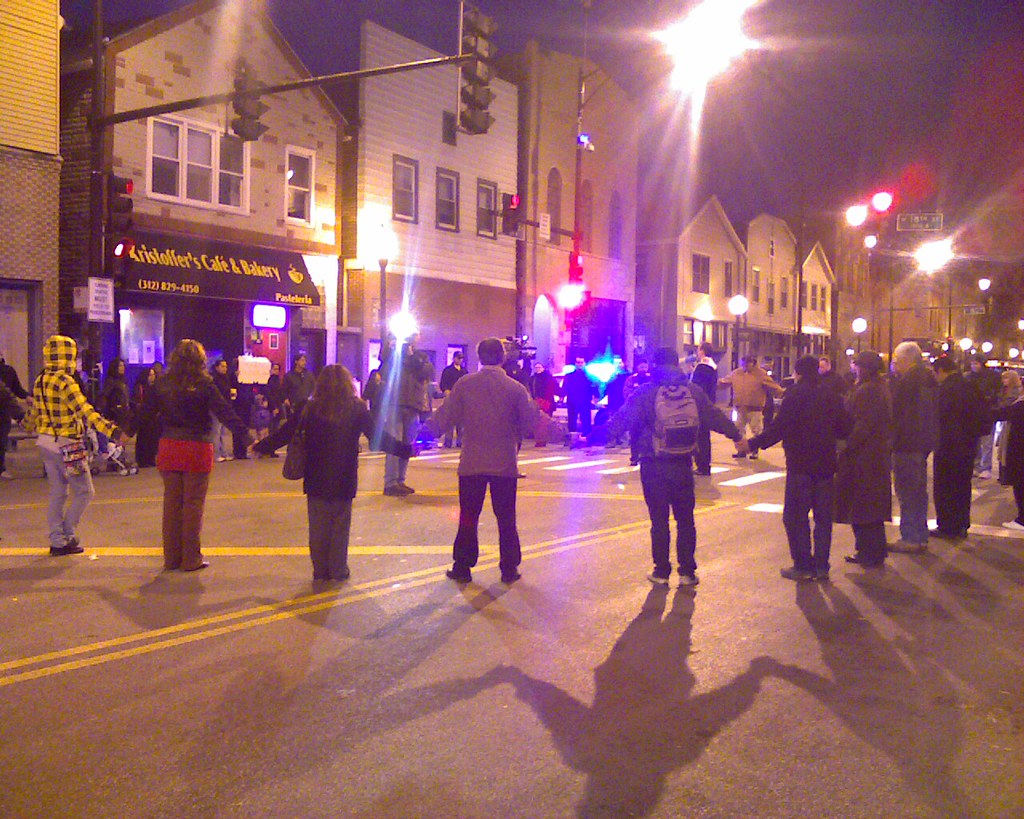
A prayer circle for Martha Gonzalez
Photo of a prayer circle for Martha Gonzalez by floozefactor/Flickr.

This is the first in a five part series on crash data analysis sponsored by Lawyer Jim Freeman.

Pedestrians and bicyclists involved in hit-and-run traffic crashes with automobiles in Chicago receive more injuries and die more often than pedestrians and bicyclists involved in hit-no-run crashes while drivers and passengers have the opposite outcome. This post attempts to describe the situation of hit-and-run crashes in Chicago.

On Sunday I wrote that 75% of all pedestrian traffic deaths this year were in hit-and-run crashes; it’s important to know that all the offending drivers were later apprehended (note 1). The horrific events on Saturday made me curious: How prevalent are hit and run crashes? I already know that our hit-and-run rate is 28.5% for 2005-2010, but how does that translate into frequency of injuries and fatalities? Are hit-and-run crashes worse for drivers, passengers, pedestrians, and cyclists? Better than hit-no-run crashes? I ran a few calculations to find the answers. I came up with more questions than answers, but my initial interpretation is that hit-and-run crashes are not much better or worse than hit-no-run crashes when looking at every crash participant combined. Continue reading What is the outcome of hit-and-run crashes?

Fatality Tracker: Two hit-and-run crashes and three deaths in one day

[flickr]photo:418206319[/flickr]

The intersection of LaSalle and Division Streets where Jesse Bradley was killed. Photo may not depict where the crash occurred. Photo by Monika Nevis. 

2012 fatality stats*:
Pedestrian: 4 (3 have been from hit-and-run crashes)
Pedalcyclist: 0
Transit: 0

According to my tracking, the city will probably maintain its status as a place with a high frequency of hit-and-run crashes as 75% of all pedestrian fatalities in Chicago this year have been because of hit-and-run drivers.

On Saturday, March 24, 2012, there were two crashes and three deaths, but only one of the three who died was a pedestrian. First, in the early morning at LaSalle Street and Division Street:

A 32-year-old man died after being hit by an SUV driven by a 21-year-old woman…

The woman fled the scene but was caught a couple blocks away, Chicago Police Department News Affairs Officer Amina Greer said. She was driving a Jeep Liberty southbound on LaSalle when she hit the man about 2:30 a.m., Greer said. [Jesse] Bradley was a third year law student at Northwestern University Law School, according to university spokesman Alan Cubbage. Chicago Tribune, 1

Assistant State’s Atty. Ericka Graunke said [Bianca] Garcia had a blood alcohol content of .168, more than double the .08 legal limit, following the early Saturday morning crash. Chicago Tribune, 2

She is charged with felony aggravated driving while under the influence resulting in death, misdemeanor reckless driving and misdemeanor driving under the influence. She is also cited with operating a vehicle without insurance, driving while unlicensed and driving the wrong way on a one-way street. Chicago Tribune, 3

Then in the evening in Brighton Park, chaos:

A horrific scene played out on the Southwest Side Saturday evening after a hit-and-run driver fled one accident [crash] only to plow into a second car, killing a toddler and a 6-year-old inside. In the wake of the 6:30 p.m. crash near 45th and Western, a witness described watching a distraught woman run from victim to victim, trying to help a 19-month-old child still strapped into a car seat lying on the street, the 6-year-old in the back seat of her demolished car and a gasping, bleeding man slumped over the wheel.

The driver of the SUV was arrested and taken to an area hospital for treatment. Chicago Sun-Times

As he [Joey Chavez] drove his 2003 Mercury Mountaineer, he rear-ended a 1997 Dodge Neon on the 4500 block of South Western Avenue that resulted in the death of 10-month-old Julissa Ochoa, 10 months, and her brother Eric, 5, officials said. Chicago Tribune

That’s three hit-and-run deaths in a single day; the first hit-and-run this year was in February on 95th Street near Cottage Grove Avenue. The baby and child are not included in fatality tracker stats at this time because they were in a car, but I think I may change my evolving fatality tracker policy to include hit-and-run deaths of car drivers and passengers.

This is as good a time as any to talk about the hit-and-run rate in Chicago, Since last reporting on hit-and-run rates in December 2011, I’ve calculated some new numbers from additional data and filtered out bike and pedestrian crashes. I will be posting about this later in the week.

See previous articles in the fatality tracker series. Grid Shots is postponed this weekend. 

* The information is only accurate as of this post’s publishing time. Post updated March 26, at 16:19, to add information about the LaSalle/Division crash. Updated March 27 at 09:16 to add charges filed against Bianca Garcia. Updated March 29 at 01:10 to add updated information about the children who died in the 4500 S Western crash.