Dottie Brackett talks women’s cycling at the Chainlink’s bike education series

[flickr]photo:7345622620[/flickr]

Last night I swung by a Chainlink Biking Semester class on biking tips for women, “The Lady and the Bike,” taught by Let’s Go Ride a Bike blogger Dottie Brackett at next Door Café, 659 W. Diversey in Lincoln Park. The Chainlink, a social networking site for Chicago cyclists, is hosting the bike ed series at the café all summer.

Vanessa Buccella, who we interviewed last winter, is teaching “Racing 101” on Tuesday, June 19, from 6:30-7:30 pm. Future Chainlink classes include “Basics To Keep Your Bike Riding Through Summer” on July 10 and “How To Not Get Your Bike Stolen and What You Can Do to Get It Back” on July 24.

Steven and I are fans of Dottie’s blog, co-written with Trisha Ping, a great source of info, especially for women, about getting around by bike without sacrificing your personal style, including great photography and fun stories of the ladies’ two-wheeled adventures. Last year I interviewed Dottie for Newcity magazine and dubbed her “The Martha Stewart of Chicago Cycling.” She didn’t seem to mind.

Continue reading Dottie Brackett talks women’s cycling at the Chainlink’s bike education series

Island delights: a bike tour of Blue Island with Active Trans’ Jane Healy

[flickr]photo:7337293650[/flickr]

Jane Healy, Mike Healy and Jason Berry.

[This piece also appeared in Checkerboard City, John’s weekly transportation column in Newcity magazine, which hits the streets in print on Wednesday evenings.]

Jane Healy is a diehard booster of the blue-collar south suburb of Blue Island, and she’s the ultimate biker mama. [I borrowed this phrase from J. Harry Wray’s book Pedal Power, which also profiles Jane, since I couldn’t think of a better term to describe her.] Along with her husband Mike and kids Will, Katie and Genevieve, she usually pedals to get around this scruffy railroad town of some 22,500 people, located just south of Chicago and straddling the Calumet-Sag Channel. Jane is board president of the Active Transportation Alliance advocacy group, and she’s been spearheading Blue Island’s current bike boom, helping get hundreds of local kids jazzed about cycling.

Continue reading Island delights: a bike tour of Blue Island with Active Trans’ Jane Healy

Calling 311 to report dangerous taxicab drivers works

Taxi driver I testified against

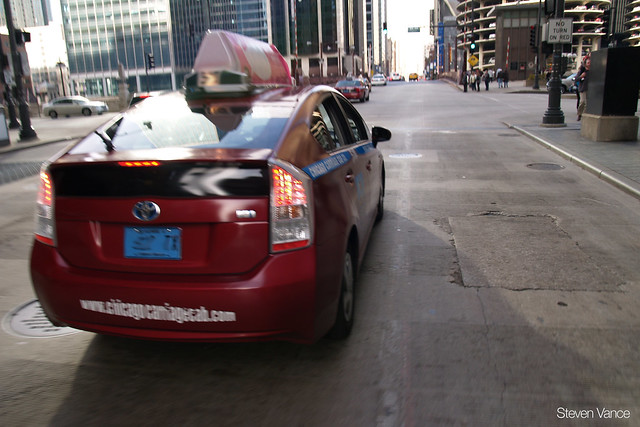
The taxi driven by the man who harassed me and against whom I testified in an administrative hearing.

This is the story of my being harassed by a taxi driver while cycling in downtown Chicago the day before Thanksgiving in November 2011. I was riding from Grant Park to meet my mother and sister for lunch at Xoco (449 N Clark). It’s also a set of loose instructions on curbing car culture.

The article is divided into three sections: the incident, the hearing, and the results. I am not revealing the taxi driver’s name or cab number: he’s already had his hearing and received due process; additionally, he may not always drive the same cab number. On the day of the incident, November 25, 2011, he leased his cab from the Chicago Carriage Cab Corp.

If you feel unsafe from the behaviors of a taxi driver, call 311 immediately after composing yourself and ask to file a complaint against a taxicab driver. You must have the time, location, and taxi number. If your immediate safety is threatened, call 911 first.

Incident

This is the description I submitted to the Chicago Department of Business Affairs and Consumer Protection, who regulate public chauffeurs.  Continue reading Calling 311 to report dangerous taxicab drivers works

How would you change the expressways in Chicago?

[flickr]photo:2622491435[/flickr]

The Bronzeville Gateway that’s hidden or shrouded on its north side by the Stevenson Expresway. Photo by Curtis Locke. 

The Metropolitan Planning Council (MPC) asked an unusual question on its Facebook page on Friday:

The Chicago area has a lot of expressways. In recent years, more new expressways have been built. If you were given as much money as you needed and were given the green light to implement any plans for the expressway system, what would you do?

Yesterday I was reading an article on Streets.MN, a land use and transportation blog, about removing urban highways in the Twin Cities (Minnapolis and St. Paul, Minnesota):

If the Twin Cities were to rid themselves of one highway, what one would it be? Or, what segment of one highway could be removed?

It noted that highways around the country have been removed over the past couple of decades, including the conversion of two elevated highways in San Francisco to boulevards (each was damaged in the Loma Prieta earthquake in 1989). It also linked to this list of 10 highway removal projects that may happen in the near future.

Then also on Friday, Congress for New Urbanism (CNU) president John Norquist (whom we interviewed in November 2011) presented a paper with Caitlin Ghoshal (also from CNU) titled “Freeways Without Futures: Possibilities for Urban Freeway Removal in Chicago“.

This white paper examines factors that make Chicago’s I-55/Lake Shore Drive and Ohio Street candidates for urban freeway removal.

[youtube]APjRC2peDVs[/youtube]

A 15-minute video of Norquist’s presentation at the Transport Chicago conference. 

I went back to the interview to find out what he had said about I-55 – Stevenson Expressway – and Ohio Street feeder ramp on the Kennedy Expressway:

The city collects no money from the Stevenson [whereas it collects taxes from retail-filled streets], and the buildings that are along it are depressed in value because it’s there. If the Stevenson east of I-94 was converted to a street more like Congress, a boulevard that connects to the street grid, that would add a lot of value to the city.

[…]

That’s until you get to Ohio, where the traffic engineers had their way and rammed a grade-separated highway all the way up to Orleans, which suppresses the property value all along it until you get to Orleans. So anything like [turning the Stevenson east of I-94 into a boulevard] will create the kind of urban complexity that people like.

I liked that idea so I responded with a brief answer on the MPC’s Facebook page:

We would replace the I-55/Lake Shore Drive connection with a boulevard so that the northern entrance to Bronzeville at King Drive is no longer in the shadow of a monstrous viaduct.

We would also convert the Ohio Street feeder ramp that connects the Kennedy to River North and points beyond with a similar boulevard so that traffic is calmer.

How would you respond to MPC’s original question about changing expressways in Chicago?

Updated June 4, 2012, at 16:55 to embed the video of Norquist’s freeways presentation from June 1, 2012. 
CDOT responds to open letter about police enforcement; still waiting for replies from mayor, police

[flickr]photo:6087624387[/flickr]

Citations issued for blocking the bike lane vary from year to year. This FedEx truck blocks the Kinzie Street protected bike lane, the city’s first. 

In the open letter that Anne Alt and I wrote and mailed in early April to Mayor Rahm Emanuel, transportation commissioner Gabe Klein (CDOT), and police superintendent Garry McCarthy, we only received a reply from Klein. We don’t expect a response from the Mayor’s Office or the Chicago Police Department.

The letter has been pasted below.

The response from CDOT pointed out an inaccuracy in our letter’s data about the number of citations issued to motorists for parking in marked bikeways (bike lanes and marked shared lanes). The data, from the Department of Administrative Hearings, substantially undercounted the number of citations issued. The issue with this data is that it came from the wrong source and the numbers from that department likely represented contested citations.

Since receiving this letter, Grid Chicago has obtained new data, from the Department of Finance (known to most as the Department of Revenue). The number of citations issued for violating Municipal Code of Chicago 9-40-060, are as follows (rates in parentheses): Continue reading CDOT responds to open letter about police enforcement; still waiting for replies from mayor, police

Fatality tracker: Person dies at Ravenswood platform

[flickr]photo:3854713664[/flickr]

A train passes over Lawrence Avenue at the Ravenswood Metra station. 

2012 Chicago fatality stats*:
Pedestrian: 6 (5 have been from hit-and-run crashes, the other person was struck by a train)
Pedalcyclist: 0
Transit: 5 (the previous four were from a 30-day period in March-April)

A northbound UP North Metra train struck and killed a person on the platform at the Ravenswood station (4800 N Ravenswood) on Tuesday, May 29. The train was not scheduled to stop there.

The pedestrian was killed in the incident, but officials are not releasing his or her identity Tuesday night, a spokesman for the Cook County Medical Examiner’s office said. CBS2

If you find more information, please leave a note or link in the comments. The station is being reconstructed.

* The information is only accurate as of this post’s publishing time and includes only people who died in the Chicago city limits. View previous Fatality Tracker posts.