Giro de Gerrymandering: pedaling the perimeter of the new First Ward

[flickr]photo:7466758406[/flickr]

Andrew Bayley’s ward map jigsaw puzzle. This and most photos in this post are by Bayley.

[This piece also runs in Time Out Chicago magazine.]

It was a blast from the past when Andrew “Cooter” Bayley, an old bike messenger colleague of mine, asked me to pedal the torturous boundaries of the newly redistricted First Ward with him. Back in January, just after City Council approved the new ward map, Bayley made headlines by using a computerized laser-cutting program to turn the map into a handsome, 50-piece Baltic Birch plywood jigsaw puzzle.

“I thought the new map was ridiculous, so I turned it into puzzle,” explained Bayley, who currently interns at an architecture firm. “Now I want to explore the interaction between this particular form of gerrymandering and the urban infrastructure that defines it.”

Continue reading Giro de Gerrymandering: pedaling the perimeter of the new First Ward
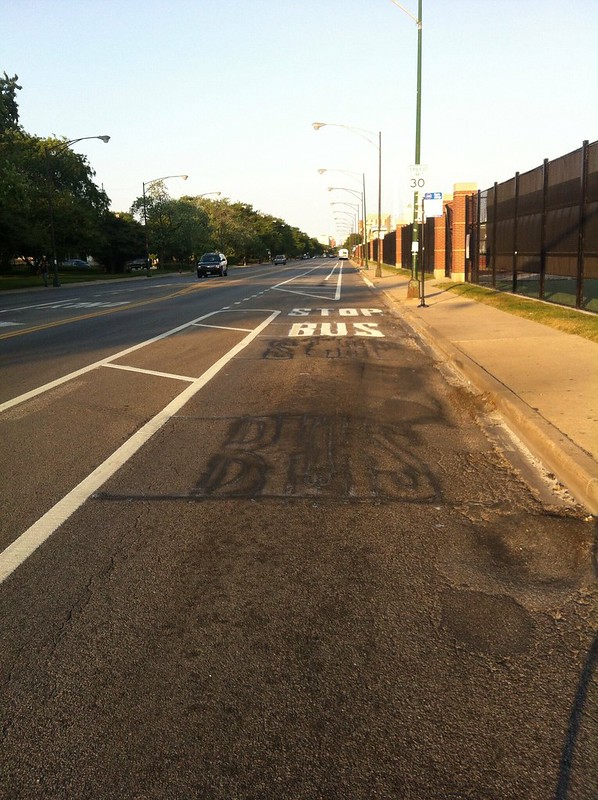
Construction of the 55th Street protected bike lane and road diet began Wednesday

55th PBL installation, Wednesday 27 June

The eastbound bike lane begins at this bus stop at Cottage Grove Avenue. 

Erik Swedlund shares these photos taken Wednesday and today of construction on 55th Street between Cottage Grove Avenue and Woodlawn Avenue.

Room for the cycle track is made possible by removing a travel lane in each direction. Elements of this project that are different from previous bike lane projects in Chicago are the mixed traffic areas for right-turn lanes and bus stops. Continue reading Construction of the 55th Street protected bike lane and road diet began Wednesday

Pier pressure: is there an alternative to the $45 million Navy Pier Flyover?

[flickr]photo:7458845842[/flickr]

Congestion on the Lakefront Trail at the Lake Shore Drive south bridge house leads to frustrating experiences, especially for those on wheels. 

The section of the Lakefront Trail between Randolph Street and Ohio Street Beach cannot comfortably handle the traffic present in the many congested areas around the Lake Shore Drive bridge, Navy Pier, and Jane Addams Memorial Park. The narrow width, awkward curves, and blind spots make for highly dissatisfied trail users, that includes the gamut of Chicagoans and visitors, using Segways, four-wheel pedal cars, skates, strollers, bicycles, wheelchairs, or their own feet. There’s not enough room for the number of people who pass through here. This section of the trail is used by individuals on work and social trips, as well as groups meandering from park to park along Lake Michigan. The City plans to build an elevated structure, called the Navy Pier Flyover, to bypass the congestion, but at an extreme cost. We propose a different project to meet the same goals of comfortable passage on the path with a much smaller price tag.

The main problem areas are at the north and south ends of the Lake Shore Drive bridge, on the sidewalk between the bridge and Grand Avenue, at the blind spot where the trail meets Grand at the corner of Lakepoint Tower’s parking garage, and in the congested area inside Jane Addams Memorial Park and Ohio Street Beach. The Navy Pier Flyover is a planned structure on the Lakefront Trail that will “fly over” these trouble spots. The Lakefront Trail path as it currently exists will remain open for those who don’t want to use the flyover. Additionally, an “off ramp” will be built from the overpass to Navy Pier alongside the Ogden Slip – this part is superfluous to addressing path congestion, but may be useful for some path users. The project does not sufficiently address congestion at Ohio Street Beach.

The Navy Pier Flyover is going to cost a jaw-dropping $45 million. To put this in perspective, in 2008 the Portland, Oregon, Bureau of Transportation estimated the entire replacement cost of its then 300-mile bike network at about $60 million. We propose an alternative solution to combat the same problems at a much lower cost, and with a far quicker construction time.

Continue reading Pier pressure: is there an alternative to the $45 million Navy Pier Flyover?

From safety to where? Discussing the future of safe streets at a CNU talk

[flickr]photo:7454454294[/flickr]

Rob Bielaski, Steven, Mark de la Vergne, Eric Dumbaugh.

By coincidence both Steven and I recently appeared on two different panels about sustainable transportation within a few days of each other. Last Thursday I was part of the talk “Chicago Cycling: What’s Next?” at the Peggy Notebaert Nature Museum in conjunction with their “Bikes! The Green Revolution” exhibit. Monday Steven participated in the discussion “Safe Streets,” hosted by the Congress for the New Urbanism (CNU) at the Jefferson Tap, 325 N. Jefferson in the West Loop. The panelists talked about what makes streets safe, and discussed new developments in Chicago street design.

Based in Chicago and headed my former Milwaukee mayor John Norquist, CNU is a nonprofit that promotes walkable, bikeable, transit-friendly, mixed-use development. Joining Steven on the panel, which doubled as CNU’s monthly happy hour, were Eric Dumbaugh, an associate professor at Florida Atlantic University who has authored more than forty books about transportation and urban planning, and Mark de la Vergne, a project manager at Sam Schwartz Engineering who has worked on Chicago’s pedestrian plan, the Streets for Cycling 2020 plan, and will be involved with siting and outreach for the city’s upcoming bike sharing program.

Continue reading From safety to where? Discussing the future of safe streets at a CNU talk

Savage ride: a trans-Chicago bike trek with Nelson Algren scholar Bill Savage

[flickr]photo:7374443002[/flickr]

Bill Savage at the McKinley Park lagoon.

[This piece also appeared in Checkerboard City, John’s weekly transportation column in Newcity magazine, which hits the streets in print on Wednesday evenings.]

“Nelson Algren wrote, ‘It isn’t hard to love a town for its greater and its lesser towers, its pleasant parks or its flashing ballet,’” says Algren scholar Bill Savage, strapping on his bicycle helmet. “‘But you never truly love it until you can love its alleys too.’ So there’s this dynamic in the city between the boulevard and the alley, between the beautiful urban spaces and the place where the garbage and the rats are, and if you really love Chicago you’ve got to love both.”

An English lecturer at Northwestern University, Bill grew up in Rogers Park with his brother, sex advice columnist Dan Savage, and still lives in the neighborhood. “I tell my students, it’s very easy to experience the city secondhand, in books and movies and online,” Bill says. “But if you’re not out there on the pavement, whether on foot or on a bicycle or in a car or on public transportation, you’re missing something.”

Continue reading Savage ride: a trans-Chicago bike trek with Nelson Algren scholar Bill Savage

Get Lit lights up 115 bikes in its first distribution event

[flickr]photo:7424285244[/flickr]

Father and daughter on their custom scraper bikes, with Skim, a volunteer. 

Because of the gracious donations of Jim Freeman and 12 donors, Get Lit held its first bike light distribution event on Friday, June 8, in Lincoln Park. Ten volunteers (Calvin, Brandon, Erik, Wilbur, Skim, Adrianna, Santiago, Jim, Rebecca, and myself) distributed lights to 115 people at Diversey Avenue and Orchard Street, and Clark Street and Diversey Avenue for two hours. The recipients included food delivery guys, couples on dates (or so I guess), a father and daughter riding through the neighborhood, and countless others who didn’t know state law (and the desire to be seen) requires a front headlight.

[flickr]photo:7424295586[/flickr]

Calvin installs a light. 

[flickr]photo:7424311942[/flickr]

This recent graduate of DePaul’s law school is happy to know he now rides a bike legally at night. 

See the full photoset.

One of the Get Lit donors has been randomly chosen to receive the Monkeylectric spoke lights I advertised in May. Derek R., please email Grid Chicago to claim it (you should have received an email announcing you as the winner). Get Lit is a partnership with Active Transportation Alliance and we are now collecting donations to put on a second event in 2012: you can donate online at Active Transportation Alliance’s special Get Lit website, mail your donation to their office with “Get Lit” in the memo (address at the end), or hand it to me.

Do you have an idea of where the next Get Lit distribution event should be? Would your business or organization like to sponsor a Get Lit event in a certain area or at an already-scheduled event? Contact me.

Active Transportation Alliance
9 W Hubbard, Suite 402
Chicago, IL 60654