My first time driving a hybrid vehicle from I-GO Car Sharing

[flickr]photo:7397833964[/flickr]

On Saturday I needed to pick up a bunch of houseplants from a home improvement store and it seemed like it would be a hassle to carry them safely on my Fresh Air bicycle trailer. Also, after a lot of procrastinating, I recently got my Chicago Card Plus, which provides access to the Chicago Transit Authority (CTA) and I-GO Car Sharing, replaced after the old one cracked and stopped functioning months ago. So this seemed like a good opportunity to try out my new card by checking out a vehicle from I-GO, the nonprofit service operated by the Center for Neighborhood Technology.

When I logged onto the I-GO website, I noticed that there were a couple of locations near my home in Logan Square with standard Toyota Prius hybrid cars. I-GO also offers plug-in electric hybrid Priuses, which they say can get 100 mile-per-gallon for trips under forty miles. This results in up to two-thirds lower fuel costs and emissions than the standard Prius, I-GO says, but currently all of the plug-in hybrids are located downtown. The service also recently added several Mitsubishi i-MiEV and Nissan LEAF electric cars to their fleet.

Continue reading My first time driving a hybrid vehicle from I-GO Car Sharing
Gimme shelter: pedestrian improvements to Congress Parkway

[flickr]photo:7332529160[/flickr]

New crosswalk with pedestrian refuge island at Congress and Dearborn.

[This piece also appeared in Checkerboard City, John’s weekly transportation column in Newcity magazine, which hits the streets in print on Wednesday evenings.]

Folks who walked to the Printers Row Lit Fest last weekend were a little less likely be killed by cars than in previous years. The Chicago Department of Transportation (CDOT) is currently wrapping up the $18 million Congress Parkway Reconstruction Project, from Wells Street to Michigan Avenue. The rehab has already brought a slew of pedestrian safety improvements, including new pedestrian refuge islands, making it safer, easier and more pleasant to walk across and along the massive street that forms the southern boundary of the Loop.

Construction on Congress began in October 2010 and the road reopened to traffic on May 15, just in time for the NATO summit. CDOT expects the final tasks, including finishing planter medians and installing decorative trellises and lighting, will be done by June 30.

Congress has long been an iconic Chicago street, but it has also been a major barrier to foot traffic. Originally called Tyler Street after tenth U.S. President John Tyler, the name was changed to honor the U.S. Congress after Tyler became unpopular because he joined the Confederacy during the Civil War. The road originates as a freeway at the Circle Interchange, the junction of the Dan Ryan, Eisenhower and Kennedy Expressways, and then continues east to become an eight-lane surface road at Wells Street, dumping high-speed traffic into the street grid.

Continue reading Gimme shelter: pedestrian improvements to Congress Parkway

Video captures “Milwaukee morning madness” as cyclists pedal towards Kinzie and Desplaines Streets

[vimeo]43679233[/vimeo]

Brandon Gobel sent us this video showing dozens – I count 27 – of people bicycling southeast on Milwaukee Avenue towards the five-way intersection with Kinzie Street and Desplaines Street. There were 13 motorized vehicles in the same signal cycle.

You’ll notice about half are changing lanes from the conventional curbside bike lane to the single travel lane so they can merge to the bike left-turn lane ahead.

[flickr]photo:6048794548[/flickr]

The view from the opposite direction, looking southeast at the intersection of Kinzie Street, Desplaines Street, and Milwaukee Avenue. 

Unfortunately, because of signal timings at the intersection they just left (Hubbard/Milwaukee) uncoordinated with their destination intersection, the first in the group won’t be rewarded with a green light for their tricky uphill lane change maneuver, and will need to stop at the red light, while those in the back of this group will likely get a slim chance at moving through a green light (the green light is only 12 seconds long).

I’ve heard from several people who cycle here, Gobel included, that changing lanes from the curbside bike lane in a dark viaduct to the travel lane in order to reach the bike left-turn lane ahead can be very stressful.

Another issue with the light, but not related to this video, is that the light cycle for people who want to cycle from Milwaukee to Kinzie (making a slight left to go eastbound) is designed such that if you enter the intersection at the end of the green phase, you will be in the intersection for the entire yellow phase, part of the red phase, and then the beginning of green phase for the cross direction. I explored this – long intersections – on my blog, Steven Can Plan.

CDOT responds to our questions about the Streets for Cycling plan

[flickr]photo:6804987991[/flickr]

John and Mike Amsden at a Streets for Cycling public meeting last winter. Photo by Serge Lubomudrov.

For many months now Chicago Department of Transportation (CDOT) project manager Mike Amsden and his team have been working hard preparing the Streets for Cycling Plan 2020. The plan now calls for creating 110 miles of protected bike lanes and 40 miles of buffered lanes by 2015, and a 640-miles bikeway network by 2020. A revised map of the network, based on input received at recent public meetings, will be unveiled on Wednesday June 15 at the Bike to Work Rally, 7:30-9 am at Daley Plaza, 50 W. Washington. The final map will be officially released with the rest of the bike plan at a later date. You can read more details about the plan here.

I had some of my own questions about the plan, and I’d also seen and heard comments from others in the comment sections of Grid Chicago and The Chainlink, and in conversations with other cyclists. Mike took some time out from his busy schedule to sit down with me at the CDOT offices, look at maps and respond to my inquiries, based on my own questions and concerns I’d heard from others. We discussed whether the plan is too ambitious, or not ambitious enough; whether the West and South Sides will get their fair share of facilities; whether the protected bike lanes offer enough protection; and what CDOT is doing to fix metal-grate bridges.

Our conversation will make more sense if you take a look at a map of the proposed 640-mile network – here’s a link to a PDF of the map. The current Chicago Bike Map is available here. Below is a map of the proposed locations for the first 150 miles of protected and buffered bike lanes – click on the image for a larger view.

[flickr]photo:7263336550[/flickr]

Continue reading CDOT responds to our questions about the Streets for Cycling plan

Going postal again: CDOT replaces bollards along the Kinzie bike lanes

[flickr]photo:7338520630[/flickr]

Spring 2011: original post configuration as seen from the top of “Fudge Hill” – photo by Josh Koonce.

[flickr]photo:7338479130[/flickr]

Early May 2012: CDOT has taken out most of the bollards.

[flickr]photo:7338337172[/flickr]

June 1, 2012: Some of the bollards have been reinstalled.

The Chicago Department of Transportation (CDOT) recently removed more that half of the flexible posts along the Kinzie Street protected bike lanes. Last month CDOT Project Manager Mike Amsden explained to me that this was done partly because of complaints from nearby residents about the appearance of the bollards.

Continue reading Going postal again: CDOT replaces bollards along the Kinzie bike lanes

Calling 311 to report dangerous taxicab drivers works

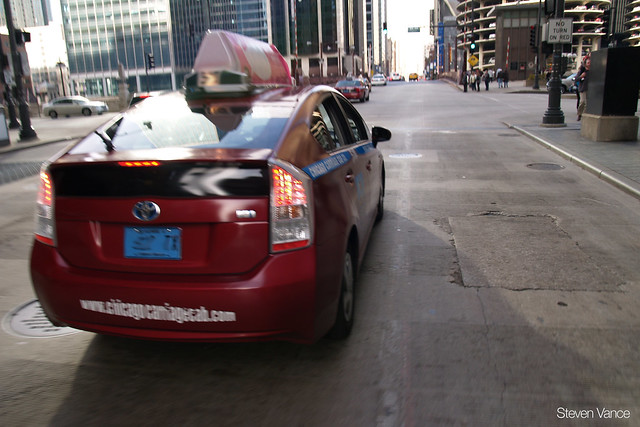
Taxi driver I testified against

The taxi driven by the man who harassed me and against whom I testified in an administrative hearing.

This is the story of my being harassed by a taxi driver while cycling in downtown Chicago the day before Thanksgiving in November 2011. I was riding from Grant Park to meet my mother and sister for lunch at Xoco (449 N Clark). It’s also a set of loose instructions on curbing car culture.

The article is divided into three sections: the incident, the hearing, and the results. I am not revealing the taxi driver’s name or cab number: he’s already had his hearing and received due process; additionally, he may not always drive the same cab number. On the day of the incident, November 25, 2011, he leased his cab from the Chicago Carriage Cab Corp.

If you feel unsafe from the behaviors of a taxi driver, call 311 immediately after composing yourself and ask to file a complaint against a taxicab driver. You must have the time, location, and taxi number. If your immediate safety is threatened, call 911 first.

Incident

This is the description I submitted to the Chicago Department of Business Affairs and Consumer Protection, who regulate public chauffeurs.  Continue reading Calling 311 to report dangerous taxicab drivers works