CDOT unveils draft Streets for Cycling plan, but there’s still time for input

[flickr]photo:7263338490[/flickr]

On Tuesday at the first of several community input meetings before the Streets for Cycling 2020 plan is finalized, the Chicago Department of Transportation (CDOT) unveiled a draft map of locations for the 110 miles of protected bike lanes (PBLs) and 40 miles of buffered lanes to be built during Rahm Emanuel’s first term.

However, the meeting focused on a new concept, the Citywide 2020 Network, a comprehensive plan for 640 miles of bikeways to be created over the next eight years – more details on this in a minute. CDOT also unveiled a draft map of this larger network at the event, held at the Copernicus Center, 5216 W. Lawrence in Jefferson Park.

Although the Streets for Cycling community input process is nearly complete, there’s still time to provide feedback before the final plan is unveiled at the Bike to Work rally on Friday, June 15. After you finish reading this post, take some time to study the two maps. If you have suggested edits to the proposed bikeway locations, see the bottom of the post for several ways you can make your voice heard.

Continue reading CDOT unveils draft Streets for Cycling plan, but there’s still time for input
Put Chicago on the path to an electrified Metra

[flickr]photo:5243266190[/flickr]

Ed. note: Roland Solinski is a graduate student of architecture at Tulane University. “I am a Chicagoan by birth and the city runs in my blood. I’m fascinated by all aspects of urban design and urban systems, but especially transit systems and public space.” Photo is of a southbound Metra Electric train. 

In November of 2010, the Chicago Tribune published an article that shocked Metra commuters. In it, Tribune reporters revealed that massive quantities of diesel exhaust were hanging in the air on platforms at Union Station and Ogilvie Transportation Center. Worse, the atmosphere inside each railcar contained the same exhaust at even higher concentrations – 72 times that of a normal city street.

In numerous other cities, commuters do not need to worry about harmful exhaust fumes, because their trains run off of electric power. In fact, many cities installed rail electrification systems at the turn of the last century specifically to eliminate toxic smoke emissions, including the Illinois Central’s line right here in Chicago, now called Metra Electric. Continue reading Put Chicago on the path to an electrified Metra

Streetcar desire: John Krause wants trams on Clark Street

[flickr]photo:7243261048[/flickr]

Krause is tired of going Nuts on Clark waiting for for the slow-moving #22 bus.

[This piece also appeared in Checkerboard City, John’s weekly transportation column in Newcity magazine, which hits the streets on Wednesday evenings.]

Acid jazz pulsed on the sound system as a group of stylishly dressed transit fans clinked wine glasses last week at Vapiano, a sleek Italian restaurant at 2577 North Clark Street in Lincoln Park. They were there to launch the Chicago Streetcar Renaissance, a campaign to create a world-class streetcar line on Clark from the Loop to Wrigley Field, and eventually add lines in other parts of the city.

“Our mission is to grow the economy and the population of Chicago every year while reducing traffic congestion and making the city easier to get around,” says John Krause, 45, the architect who founded the movement, nattily attired in jeans and a dove-gray sports jacket. “That means every year there will be more people and fewer cars, more commerce and less congestion.”

He has a vision of the clogged traffic and the notoriously sluggish buses on Clark replaced by efficient, comfortable streetcars, more pedestrian traffic, on-street cafés and broad bike lanes. “The only way you can get rid of cars is to replace them with something better,” he explains. “In a car paradigm everybody assumes the city is going to grow more and more congested. But a public transit system is the opposite. The more people who use public transit, the better it gets.”

Continue reading Streetcar desire: John Krause wants trams on Clark Street

Lake Street protected bike lane construction began this morning

[flickr]photo:7243846640[/flickr]

Crews started constructing a protected bike lane this morning on Lake Street between Damen Avenue (connecting to an existing bike lane to the north) and Conservatory Drive/Central Park Avenue (connecting to an existing bike lane). This will add 2 miles to the 25 miles-per-year protected bike lane network. Between Damen Avenue and Talman Avenue, the street’s overhead ‘L’ has its columns on the sidewalk, while from Talman Avenue to Conservatory Drive/Central Park Avenue and beyond the columns are in the roadway. Grid Chicago has asked the Department of Transportation (CDOT) for the bike lane plans for this street to understand how the roadway columns will affect parking and the bike lane design. We have a “before” video already filmed, so it will be interesting to watch the comparison to the “after” video.  Follow the jump for more photos and a map

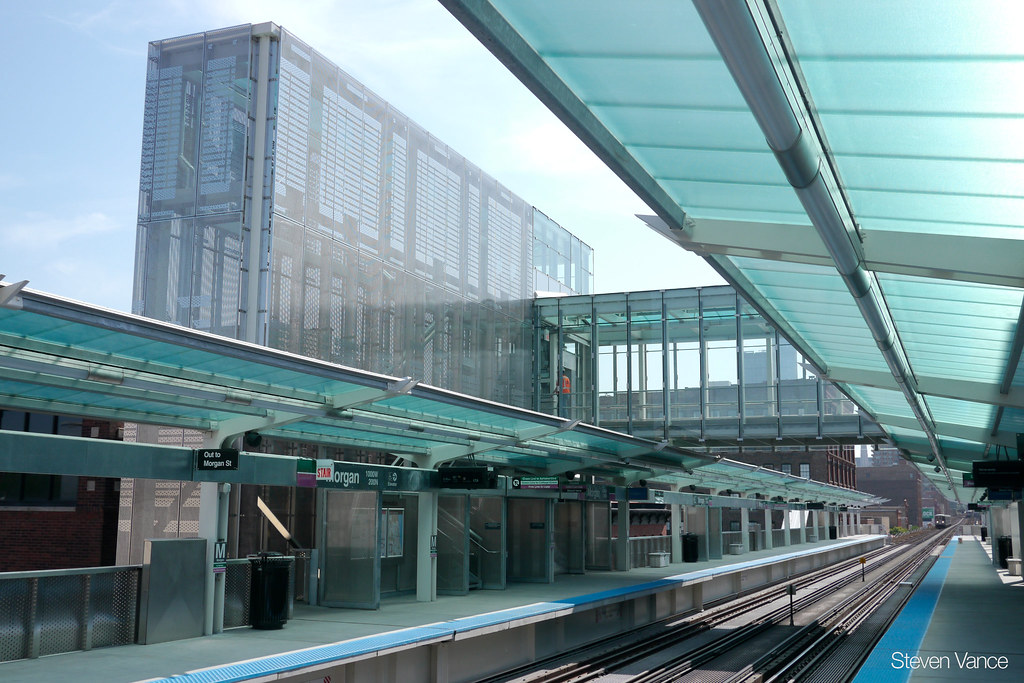
West Loop gains new transit option with today’s opening of CTA Morgan station

First day of CTA Morgan Station serving the Green and Pink Lines

The fully enclosed glass and metal stairways and transfer bridge make an architectural and industrial statement in the growing West Loop neighborhood. 

The CTA has opened two new stations within three weeks of each other. The first was Oakton-Skokie on the Yellow Line in Skokie, Illinois, on April 30, and today the Morgan Green/Pink Line station opened (without fanfare). A grand opening will likely happen June 1.

Continue reading West Loop gains new transit option with today’s opening of CTA Morgan station

A post about posts: why CDOT took out bollards along the Kinzie lanes

[flickr]photo:7221274724[/flickr]

Messenger John “Blunt” Robbins rides in a section of Kinzie without parking, where every-other post has been removed.

It was a little mysterious when the Chicago Department of Transportation (CDOT) recently removed more than half of the flexible posts (AKA bollards) that separate the Kinzie protected bike lanes from parked cars and moving traffic. So I called CDOT bikeways planner Mike Amsden, to get the skinny. He explained the motivations for taking out the posts, and also pointed out a few recent upgrades to the street I hadn’t noticed before.

Continue reading A post about posts: why CDOT took out bollards along the Kinzie lanes