CDOT responds to our questions about the Streets for Cycling plan

[flickr]photo:6804987991[/flickr]

John and Mike Amsden at a Streets for Cycling public meeting last winter. Photo by Serge Lubomudrov.

For many months now Chicago Department of Transportation (CDOT) project manager Mike Amsden and his team have been working hard preparing the Streets for Cycling Plan 2020. The plan now calls for creating 110 miles of protected bike lanes and 40 miles of buffered lanes by 2015, and a 640-miles bikeway network by 2020. A revised map of the network, based on input received at recent public meetings, will be unveiled on Wednesday June 15 at the Bike to Work Rally, 7:30-9 am at Daley Plaza, 50 W. Washington. The final map will be officially released with the rest of the bike plan at a later date. You can read more details about the plan here.

I had some of my own questions about the plan, and I’d also seen and heard comments from others in the comment sections of Grid Chicago and The Chainlink, and in conversations with other cyclists. Mike took some time out from his busy schedule to sit down with me at the CDOT offices, look at maps and respond to my inquiries, based on my own questions and concerns I’d heard from others. We discussed whether the plan is too ambitious, or not ambitious enough; whether the West and South Sides will get their fair share of facilities; whether the protected bike lanes offer enough protection; and what CDOT is doing to fix metal-grate bridges.

Our conversation will make more sense if you take a look at a map of the proposed 640-mile network – here’s a link to a PDF of the map. The current Chicago Bike Map is available here. Below is a map of the proposed locations for the first 150 miles of protected and buffered bike lanes – click on the image for a larger view.

[flickr]photo:7263336550[/flickr]

Continue reading CDOT responds to our questions about the Streets for Cycling plan
Going postal again: CDOT replaces bollards along the Kinzie bike lanes

[flickr]photo:7338520630[/flickr]

Spring 2011: original post configuration as seen from the top of “Fudge Hill” – photo by Josh Koonce.

[flickr]photo:7338479130[/flickr]

Early May 2012: CDOT has taken out most of the bollards.

[flickr]photo:7338337172[/flickr]

June 1, 2012: Some of the bollards have been reinstalled.

The Chicago Department of Transportation (CDOT) recently removed more that half of the flexible posts along the Kinzie Street protected bike lanes. Last month CDOT Project Manager Mike Amsden explained to me that this was done partly because of complaints from nearby residents about the appearance of the bollards.

Continue reading Going postal again: CDOT replaces bollards along the Kinzie bike lanes

Does the new “tied arch” bridge on Halsted encourage speeding?

[flickr]photo:7303499664[/flickr]

Approaching the new bridge from the south. Here there are two travel lanes, bike lanes and parking lanes.

When new bridges are built in Chicago, the Illinois Department of Transportation (IDOT) generally requires that they be built to accommodate projected traffic demands. The assumption is that in the future there will be more people driving than ever before, although most of us hope this won’t be the case.

So when the Chicago Department of Transportation (CDOT) rebuilt the North Damen Avenue bridge over the Chicago River in 2002, IDOT insisted that the old two-lane bridge be replaced with a four-lane, although Damen is generally only a two-lane street. But as a rule, if you give Chicago drivers the opportunity to speed, they will.

So it shouldn’t have been a surprise that as soon as the new bridge opened, motorists took advantage of the new half mile of wide open space between stoplights at Fullerton and Diversey to put the pedal to the metal. The speeding cars, plus the fact that bike lanes weren’t included in the project, turned a formerly bikeable bridge on a recommended bike route into a hostile environment for cyclists.

Continue reading Does the new “tied arch” bridge on Halsted encourage speeding?

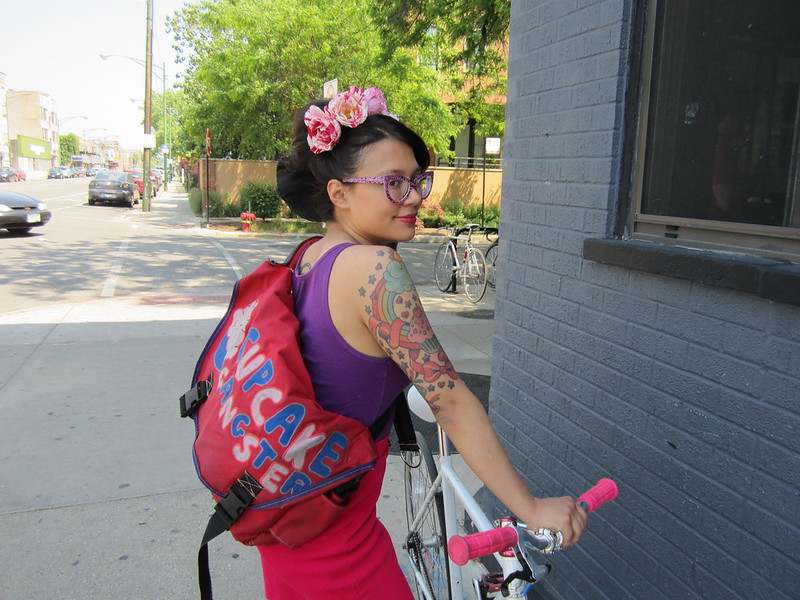
Gangster rap: an interview with bike style icon Lorena Cupcake

Lorena Cupcake

[This piece also appeared in Checkerboard City, John’s weekly transportation column in Newcity magazine, which hits the streets in print on Wednesday evenings.]

In a Midwestern town where folks dress conservatively, bike style icon Lorena Cupcake stands out like a handful of Skittles scattered across the Wall Street Journal. Easily spotted by her candy-colored outfits, rainbow-and-lollipops tattoo and messenger bag emblazoned “Cupcake Gangster,” she’s also an astute commentator on the local cycling, drinking and foodie scenes via her frequently updated, often hilarious Twitter feed.

But Cupcake, 25, is far from just a hipster gadfly. A frequent participant and volunteer at “alleycats,” underground, messenger-style checkpoint races, she runs the bike event Twitter calendar @chicagoholdup and helps stage the annual Bicycle Film Festival. Last year she and a few other petite fixed-gear enthusiasts formed Tiny Fix, a bike gang especially for women under 5’2”, which organizes bar nights, dance parties and now their first alleycat, last weekend’s Tiny Fix Ace Race.

I recently caught up with Cupcake, fresh off her day job as a bank teller, over $3 cheeseburgers at the Blue Frog, a messenger bar at 676 N. LaSalle in River North. She gave me the skinny on Tiny Fix, the upcoming race, and the things she loves and hates about biking in Chicago.

Continue reading Gangster rap: an interview with bike style icon Lorena Cupcake

Streetcar desire: John Krause wants trams on Clark Street

[flickr]photo:7243261048[/flickr]

Krause is tired of going Nuts on Clark waiting for for the slow-moving #22 bus.

[This piece also appeared in Checkerboard City, John’s weekly transportation column in Newcity magazine, which hits the streets on Wednesday evenings.]

Acid jazz pulsed on the sound system as a group of stylishly dressed transit fans clinked wine glasses last week at Vapiano, a sleek Italian restaurant at 2577 North Clark Street in Lincoln Park. They were there to launch the Chicago Streetcar Renaissance, a campaign to create a world-class streetcar line on Clark from the Loop to Wrigley Field, and eventually add lines in other parts of the city.

“Our mission is to grow the economy and the population of Chicago every year while reducing traffic congestion and making the city easier to get around,” says John Krause, 45, the architect who founded the movement, nattily attired in jeans and a dove-gray sports jacket. “That means every year there will be more people and fewer cars, more commerce and less congestion.”

He has a vision of the clogged traffic and the notoriously sluggish buses on Clark replaced by efficient, comfortable streetcars, more pedestrian traffic, on-street cafés and broad bike lanes. “The only way you can get rid of cars is to replace them with something better,” he explains. “In a car paradigm everybody assumes the city is going to grow more and more congested. But a public transit system is the opposite. The more people who use public transit, the better it gets.”

Continue reading Streetcar desire: John Krause wants trams on Clark Street

More on the Chicago Forward Action Agenda: Congestion mitigation, truck deliveries, bike messengers

[flickr]photo:6291428175[/flickr]

People riding a bicycle and driving a truck, respectively, share the road on Monroe Street in downtown Chicago. Trucks occupy a section of CDOT’s two-year plan. Photo by Joseph Dennis. 

The Chicago Department of Transportation on May 11 released its 100-page, two-year plan to “ensure that Chicago continues to be a vibrant international city, successfully competing in the global economy with a transportation system that provides high- quality service to residents, businesses, and visitors”. That’s the Chicago Forward Action Agenda’s vision statement. Grid Chicago talked to CDOT commissioner Gabe Klein that day about the plan’s development, role in shaping the transportation systems in the city, and select performance measures and action items. In the first part, we discussed the deep partnership with CTA and CDOT, public outreach for the plan (via the Pedestrian and Streets for Cycling planning processes), and eliminating all traffic fatalities. In this part, we talk about congestion, enfacing and consolidating loading zones, and bicycle and truck deliveries.

Download Chicago Forward (13 MB .pdf) to follow along.

There are many performance measures that don’t seem to be performances measures at all. For example, “improve CTA’s on-time performance” on page 41. So if you improve it 1% over 10 years, has the plan achieved the right level of performance?

That’s a very fair criticism. What you have to understand, we don’t run CTA. What we’re trying to do there is let people know that that’s a goal we’re working on. I can very much see your point. In some cases, we just can’t give measurable goals because it wouldn’t be fair to that agency.

It’s not going to be perfect, but I’d rather put something out and actually have goals for the agency, even if we don’t hit 100% of the goals, but 90% of the goals, than have a perfect plan. Continue reading More on the Chicago Forward Action Agenda: Congestion mitigation, truck deliveries, bike messengers