A game of cat & mouse: revisiting John’s old CBF cartoons

[flickr]photo:7034189059[/flickr]

Steve Buchtel, who did a brilliant job of editing the Chicagoland Bicycle Federation’s (CBF) newsletter in the late ’90s and early 2000s, recently left his job as Southland Coordinator with Active Transportation Alliance to take the helm of Trails for Illinois, advocating for new greenways. Cleaning out his files recently he came upon a few cartoons I submitted for the newsletter back in 1998-99. Yes, I was a 28-year-old adult when I drew these doodles of cyclists as mice and drivers as cats, inspired by Art Spiegelman’s Maus comics.

The above cartoon was a reaction to 44th Ward Alderman Bernie Hansen sending a crew out to paint out the bike lanes that the Chicago Department of Transportation (CDOT) had installed on Halsted Street in Boystown. Hansen felt there hadn’t been enough input from the local business owners. Why is it that Chicago aldermen named Bernie tend to be anti-bike? Not long afterwards Hansen retired and was replaced by bike-friendly alderman Tom Tunney, and CDOT re-striped the lanes. This cartoon was a bit too edgy for the CBF News – they didn’t run it.

Continue reading A game of cat & mouse: revisiting John’s old CBF cartoons
Protest against low transit funding on Wednesday is directed at the wrong audience

[flickr]photo:6355381869[/flickr]

One of the buses Pace uses on the Stevenson Expressway shoulders during rush hours. The two routes have seen a lot of demand and Pace is responding by adding more runs. Photo by Ann Fisher. 

On Wednesday, people will gather at the Chicago Transit Authority headquarters (567 W Lake Street) to protest “inadequate funding and policies”, according to the Red Eye. Members from at least two groups (LVEJO and Citizens Taking Action) will join to protest public-private partnerships and to support laid off bus drivers. This is part of a larger National Day of Action for Public Transportation called by Occupy Boston.

They are protesting in the wrong location. They should be rallying at locations where there are people who can do something about underfunded transit: the offices of elected officials, like at City Hall and those of state and federal Congresspersons scattered around town. Continue reading Protest against low transit funding on Wednesday is directed at the wrong audience

Bike counts are important to businesses and in evaluating our progress

[flickr]photo:6880697670[/flickr]

Alyson Fletcher counts cyclists on 18th Street. 

The need for knowing how many people are cycling in Chicago should be obvious: to plan a good bikeway network that considers where people are already cycling; and to track the progress of the Bike 2015 Plan and other related plans. There are multiple needs to count cyclists in Chicago, for civic planning, academic research, and business promotion. On Tuesday morning and afternoon last week, volunteers at several downtown Chicago intersections were armed with pencil and paper to count people cycling (towards downtown in the morning, away from in the afternoon).

The City’s bike count program is now getting into a groove of consistent and periodic tabulating after a time of sporadic counts in different locations (mostly for single facility analysis). A good bike count program is permanent, counting people at the same times on a regular basis at the same location. The new program, which started in 2011, will count cyclists at the same places in downtown Chicago, at the same time each month. Not only can the City use this information to plan a network (and hopefully more bikeways in the Loop), but it can be used to track the impact of bikeways and cyclists on ridership and traffic, respectively. Continue reading Bike counts are important to businesses and in evaluating our progress

Bike count projects in Chicago: two short video interviews

[flickr]photo:6880697670[/flickr]

Bike counts are getting more attention this year than in previous years. Watch these two short interviews to get a little insight on how. A full story will be published later.

[vimeo]39390347[/vimeo]

Alyson Fletcher is a graduate student from Cornell University in Ithaca, New York; she’s also volunteered for Active Transportation Alliance. She was here last week to count cyclists on 18th Street and Kinzie Street. Watch the video to learn more about her masters project.

[vimeo]39391256[/vimeo]

Alessandro Panella volunteered for the Chicago Department of Transportation’s (CDOT) quarterly downtown bike count on Tuesday. Watch the video to learn about the responsibilities he had at Randolph and Canal Streets, and his idea to make a robust bike count program.

Watch all of our other videos on the blog, or on Vimeo.

P.S. It was after my interview with Fletcher that I photographed two people driving in the bike lane.

Photo of Fletcher filling out her counting chart (tally sheet).

What is the outcome of hit-and-run crashes?

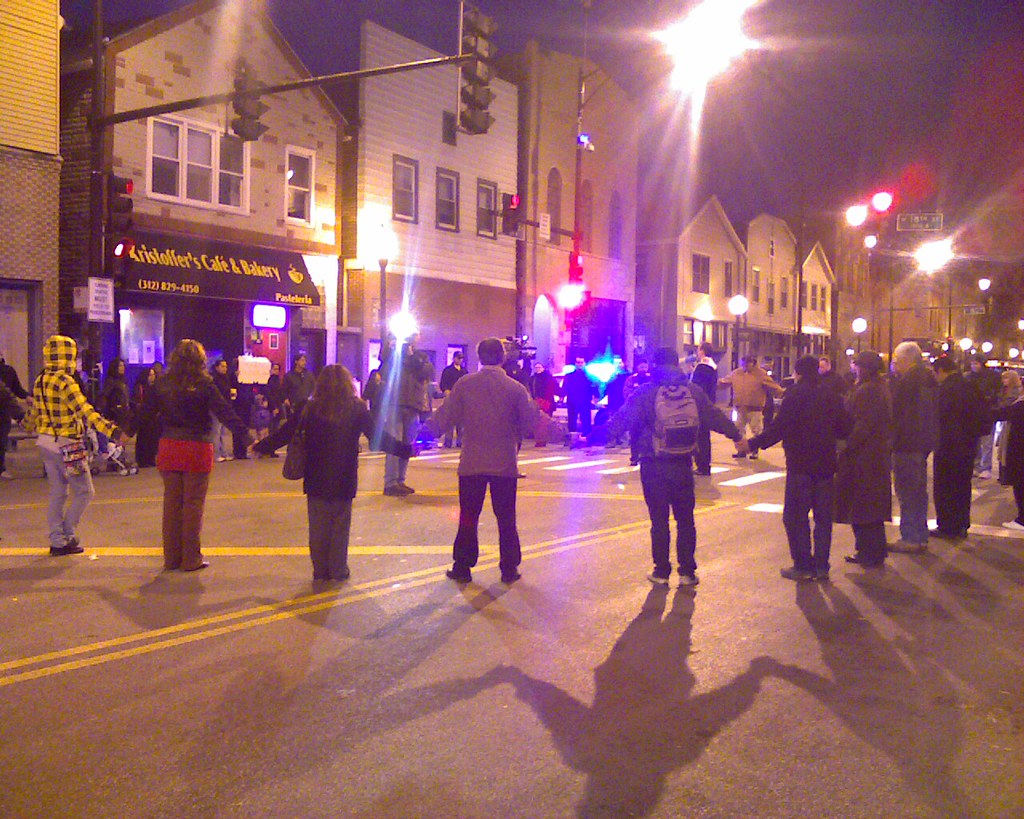
A prayer circle for Martha Gonzalez
Photo of a prayer circle for Martha Gonzalez by floozefactor/Flickr.

This is the first in a five part series on crash data analysis sponsored by Lawyer Jim Freeman.

Pedestrians and bicyclists involved in hit-and-run traffic crashes with automobiles in Chicago receive more injuries and die more often than pedestrians and bicyclists involved in hit-no-run crashes while drivers and passengers have the opposite outcome. This post attempts to describe the situation of hit-and-run crashes in Chicago.

On Sunday I wrote that 75% of all pedestrian traffic deaths this year were in hit-and-run crashes; it’s important to know that all the offending drivers were later apprehended (note 1). The horrific events on Saturday made me curious: How prevalent are hit and run crashes? I already know that our hit-and-run rate is 28.5% for 2005-2010, but how does that translate into frequency of injuries and fatalities? Are hit-and-run crashes worse for drivers, passengers, pedestrians, and cyclists? Better than hit-no-run crashes? I ran a few calculations to find the answers. I came up with more questions than answers, but my initial interpretation is that hit-and-run crashes are not much better or worse than hit-no-run crashes when looking at every crash participant combined. Continue reading What is the outcome of hit-and-run crashes?

A Complete Streets “heads up” for Division Street

[flickr]photo:7000471213[/flickr]

Plan drawings show lack of bicycle accommodations. 

Last year I requested from the city plan drawings for the bridge replacement and road reconstruction at Halsted Street and the north branch canal (near Division Street). Included in the response to my FOIA request were plan drawings from the Department of Transportation’s Division of Engineering for a complementary project, the reconstruction of Division Street between Cleveland Street (east) and the railroad viaduct by the McGrath Lexus dealer (west).

So no one is caught off guard like some felt in regards to the Fullerton Avenue/Lake Shore Drive project, I wanted to give a heads up for a project that I think lacks consideration of the principles of complete streets and Chicago’s Complete Streets policy. In other words, what is proposed is not a complete street. Continue reading A Complete Streets “heads up” for Division Street